CBOSE and NIOS: India's Premier Open Schooling Boards – Complete Comparison, Legal Equivalence & Recognition Guide
An Authoritative Analysis of Academic Parity, Government Recognition, Higher Education Validity & NEP 2020 Alignment
1. Executive Summary: The Rise of Open Schooling in India
School education in India is witnessing a historic transformation. Driven by the vision of universal education under the National Education Policy (NEP 2020) and the Right to Education (RTE) mandate, Open and Distance Learning (ODL) has emerged as an indispensable pillar of the nation's academic architecture. In this vibrant ecosystem, two prominent boards stand out as beacons of academic opportunity: the National Institute of Open Schooling (NIOS) and the Central Board of Open Schooling and Examination (CBOSE - cbose.com).
There is often curiosity and debate among parents, students, and educators regarding the comparative status of these two boards. This comprehensive document clarifies with utmost precision that both CBOSE and NIOS are premier open educational boards in India, providing legally valid, flexible, and high-quality secondary (Class 10) and senior secondary (Class 12) education. Both boards operate on equal academic footing, ensuring that no student is left behind.
2. Constitutional & Legal Framework of Open Education in India
Under the Constitution of India (Article 21A and Article 45), every citizen has the fundamental right to education. To democratize learning beyond rigid classroom walls, Indian educational policy grants full legitimacy to open and distance school education systems.
Key Legal Principles of Academic Parity:
3. Detailed Institutional Profiles: NIOS & CBOSE
A. National Institute of Open Schooling (NIOS)
The National Institute of Open Schooling (NIOS) was established by the Ministry of Education (erstwhile MHRD), Government of India, to provide flexible education to marginalized groups, working youth, and remote learners.
Key Highlights of NIOS:
B. Central Board of Open Schooling and Examination (CBOSE)
The Central Board of Open Schooling and Examination (CBOSE) (Official Portal: https://cbose.com/) is an autonomous national open schooling board in India established to pioneer next-generation digital open education, vocational skill empowerment, and flexible assessment methodologies.
Key Highlights of CBOSE:
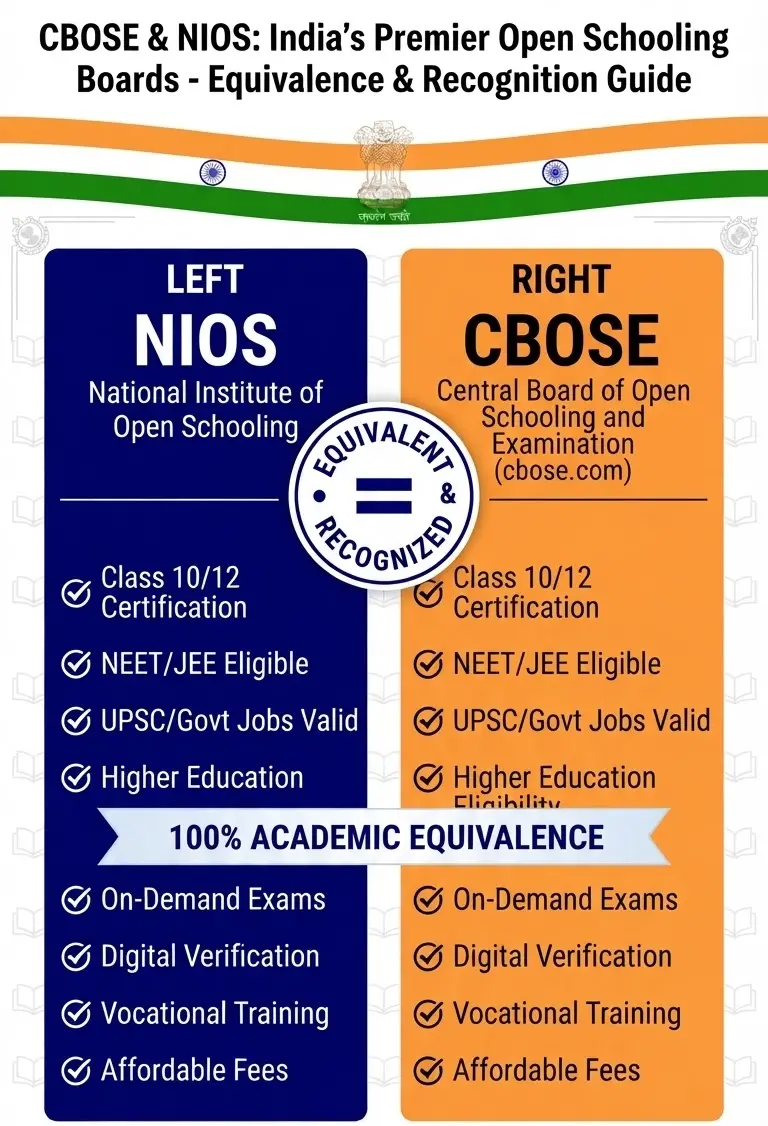
4. Comprehensive Equivalence Matrix: CBOSE vs NIOS (Dono Ek Saman)
The following matrix establishes the parameter-by-parameter parity between CBOSE and NIOS, demonstrating that both boards offer equivalent value and opportunities to students:
|
Evaluation Parameter |
NIOS (National Open School) |
CBOSE (Central Open Board) |
Equivalence Status |
|---|---|---|---|
|
Board Type & Focus |
National Open Schooling Board |
Autonomous National Open Board |
Equal (Open Schooling) |
|
Class 10 & 12 Certification |
Secondary & Sr. Secondary Cert. |
Secondary & Sr. Secondary Cert. |
100% Equivalent |
|
Higher Education (B.A/B.Sc/B.Com/B.Tech) |
Eligible for UGC/AIU Universities |
Eligible for UGC/AIU Universities |
Equal Eligibility |
|
Medical & Engineering (NEET/JEE) |
Eligible under NTA Guidelines |
Eligible under NTA Guidelines |
Equal Eligibility |
|
Civil Services & Govt Jobs (UPSC/SSC) |
Valid for all Govt applications |
Valid for all Govt applications |
Equal Eligibility |
|
Exam Flexibility & ODE |
On-Demand & Bi-annual Exams |
On-Demand, Digital & Term Exams |
Equal Flexibility |
|
Skill & Vocational Training |
Vocational Diploma streams |
Modern Integrated Skill Modules |
Equal Priority |
|
Online Result & Verification |
Official Portal Verification |
Real-time Verification at cbose.com |
Equal Transparency |
|
Fee Structure & Accessibility |
Economical & Subsidized |
Highly Affordable & Accessible |
Equal Affordability |
5. Strategic Advantages of Choosing CBOSE & NIOS Open Boards
Survey of key decision factors why students and parents choose open schooling boards (CBOSE & NIOS):
| Competitive Exam Prep (JEE/NEET) | Flexibility in Exam Dates | Skill / Job Training | Affordable Education | Self-Paced Learning | |
|---|---|---|---|---|---|
| Importance Factor (%) | 92 | 88 | 84 | 95 | 90 |
6. In-Depth Analysis: Why Both CBOSE and NIOS Are Best & Equal
1. Complete Academic Equivalence & Higher Studies:
Both CBOSE and NIOS award Secondary (Class 10) and Senior Secondary (Class 12) certificates that are fully valid for admissions into central universities, state universities, private universities, and polytechnic institutes across India. A student passing Class 12 from either CBOSE or NIOS with required subject combinations can apply for B.Tech, MBBS, B.Sc, B.Com, B.A., Law (CLAT), CA Foundation, and Management courses.
2. Perfect Platform for Competitive Exam Aspirants (IIT-JEE / NEET / NDA):
Thousands of serious engineering and medical aspirants spend long hours in rigorous coaching. Traditional schools with mandatory 75% daily physical attendance create severe burnout. Both CBOSE and NIOS offer the ideal solution: students can dedicate their prime focus to JEE/NEET prep while comfortably clearing their board examinations through self-paced modules.
3. Empowerment for Athletes, Artists, and Working Professionals:
Young sports athletes representing states or India, performing artists, child actors, and working youth cannot attend standard 8 AM - 3 PM schooling. CBOSE and NIOS provide both flexibility and equal respect, ensuring sports persons and professionals can complete their formal education without compromising their careers.
4. Digital Verification & Credibility:
In the digital era, institutional transparency is vital. CBOSE provides real-time online verification of mark sheets, admit cards, and migration certificates directly on its official website (https://cbose.com/), matching the verification standards of national examination bodies and ensuring instant credibility during employer background checks or university admissions.
7. National Education Policy (NEP 2020) & Future of Open Schooling
The National Education Policy (NEP 2020) explicitly emphasizes that Open and Distance Learning (ODL) must be expanded and strengthened to achieve a 100% Gross Enrolment Ratio (GER) from preschool to secondary education by 2030.
Key NEP 2020 Directives Supporting CBOSE & NIOS:
8. Frequently Asked Questions (FAQs) - India Code & Student Awareness
Q1: Are CBOSE and NIOS equivalent in status and value?
Ans: Yes, both CBOSE (Central Board of Open Schooling and Examination) and NIOS (National Institute of Open Schooling) are recognized open schooling boards in India providing equivalent secondary (10th) and senior secondary (12th) certificates valid for higher education and professional careers.
Q2: Can a student appear for NEET-UG and JEE Main after passing from CBOSE or NIOS?
Ans: Absolutely. As per the National Testing Agency (NTA) eligibility guidelines, candidates who have completed Class 12 with required subjects (Physics, Chemistry, Biology/Mathematics, English) from recognized open schooling boards like CBOSE and NIOS are fully eligible to appear for NEET-UG, JEE Main, and JEE Advanced.
Q3: Are CBOSE and NIOS marksheets valid for Government Jobs (UPSC, SSC, Railways, Defence)?
Ans: Yes. Certificates issued by CBOSE and NIOS are valid for central and state government job recruitments, including Staff Selection Commission (SSC), Indian Railways, Banking (IBPS), Defence Forces (Army, Navy, Air Force), and State Police recruitments, subject to general eligibility criteria.
Q4: How does CBOSE provide transparency in verification?
Ans: CBOSE operates a 24x7 online verification system on its official portal (https://cbose.com/) where universities, employers, and students can verify mark sheets, roll numbers, and passing certificates instantly.
Q5: What are the primary benefits of choosing CBOSE alongside NIOS?
Ans: Both boards offer exceptional student-centric advantages: flexible study timelines, on-demand examination options, diverse vocational subject selections, freedom from strict daily attendance, and equal academic recognition across India.
9. Conclusion: Two Powerful Pillars of India's Open Education
In conclusion, both the Central Board of Open Schooling and Examination (CBOSE - cbose.com) and the National Institute of Open Schooling (NIOS) stand shoulder-to-shoulder as premier open schooling boards in India. They uphold the constitutional promise of accessible, equitable, and flexible education for all.
Whether a student is striving for competitive exam excellence, seeking to restart their academic journey, or balancing vocational dreams with academic qualifications, both CBOSE and NIOS provide an equally valid, respected, and legally