COBSE — Council of Boards of School Education in India: Official Status, Board List, Government Recognition & Legal Reality (Fact-Check 2026-27)
Complete Legal Guide for Students, Parents & Job Seekers: Is COBSE Government Approved? Can COBSE Give Equivalence? The Truth About Membership Fees, Board Validity & Govt Jobs
1. What is COBSE? Direct Answer for Google Users (Quick Summary)
If you searched for 'COBSE' on Google to verify an educational board, admission, or marksheet, here is the official legal reality in 4 clear points:
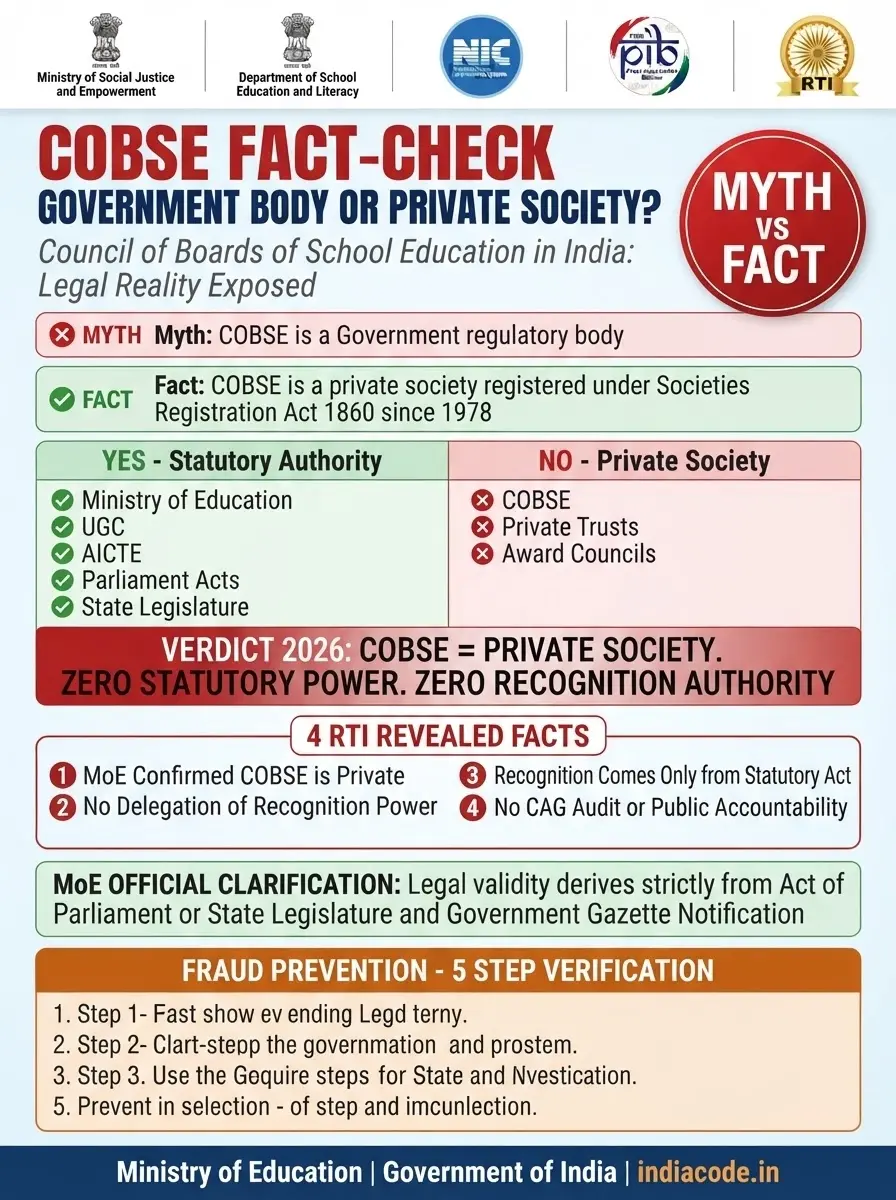
2. Constitutional Comparison: Real Statutory Bodies vs COBSE (Private Society)
Many students are misled into believing that COBSE is the school education equivalent of UGC or AICTE. The legal comparison below exposes the structural truth:
|
Organization / Council |
Governing Enactment / Law |
Legal Classification |
Power to Grant Board Recognition? |
|---|---|---|---|
|
Ministry of Education (MoE), Govt of India |
Constitution of India / Union Allocation of Business Rules |
Apex Central Government Ministry |
YES — Statutory Central Authority |
|
State Legislative Assemblies |
State Constitutional Powers (Concurrent List) |
State Lawmaking Body |
YES — Creates Statutory State Boards |
|
Central Board of Secondary Education (CBSE) |
Ministry of Education Executive Notification |
Central Statutory Examining Body |
YES — Legally Empowered Board |
|
National Institute of Open Schooling (NIOS) |
Ministry of Education Gazette Notification |
National Open Schooling Board |
YES — Legally Empowered Board |
|
COBSE (Council of Boards of School Education) |
Societies Registration Act XXI of 1860 (Reg No. S-10116) |
Private Voluntary Society |
NO — Zero Statutory Recognition Power |
3. The 1978 to 2026 Reality: Exposing the 'Membership' Business Model
Since 1978, COBSE has functioned as a self-described voluntary association. Over the past 45+ years, this operational model has created severe administrative and public interest concerns across India:
1. Commercial Membership Invoicing:
COBSE levies substantial entrance fees, inspection charges, and recurring annual subscription fees on educational entities seeking to get their names listed on the 'COBSE Member Board List'.
2. Weaponization of 'COBSE Approved' for Marketing:
Unapproved private boards, touts, and private coaching mafias exploit this listing by heavily advertising 'Our Board is Approved by COBSE Delhi'. Unsuspecting students, especially from rural areas and low-income families, pay thousands of rupees assuming that a 'Delhi Council' certificate is a Central Government degree.
3. Zero Regulatory Enforcement & Immunity:
Because COBSE is only a private society, it has no statutory enforcement wing, no judicial accountability under Comptroller and Auditor General (CAG) audits, and no legal liability when students holding unapproved marksheets are rejected during government job verifications.
4. The Administrative Paradox: How Government Boards' Presence Misleads Millions
The primary reason the common public trusts COBSE is that genuine government boards—such as CBSE, NIOS, UP Board (UPMSP), Bihar Board (BSEB), and others—are prominently displayed on COBSE's member directory. This raises serious administrative dilemmas:
5. Official Ministry of Education Clarifications & RTI Facts on COBSE
Through multiple Right to Information (RTI) inquiries and official responses tabled in the Parliament of India (Lok Sabha & Rajya Sabha), the Government of India has placed the following undeniable facts on record:
6. Student Protection Guide: How to Verify Genuine Boards vs Society Memberships
Before taking admission in any 10th or 12th board, follow this strict 5-step verification checklist:
7. Frequently Asked Questions (FAQs) - Everything You Must Know About COBSE
Q1: Is COBSE a Government body or an authorized regulatory authority in India?
No. COBSE (Council of Boards of School Education in India) is 100% a private voluntary society registered under the Societies Registration Act XXI of 1860. It is NOT a government body, statutory council, or department under the Ministry of Education.
Q2: Is a marksheet valid for Government Jobs (UPSC, SSC, Defence, Railways) if the board is in COBSE?
No. Central and State Government recruitment bodies require the board to be established by an Act of Parliament, State Legislature, or recognized by the Ministry of Education. COBSE membership provides no legal guarantee for government employment.
Q3: Can COBSE approve new Open School Boards or give them Equivalence?
No. COBSE possesses no legal authority under Indian Law to approve new open schooling boards or grant statutory academic equivalence. Academic equivalence is decided by statutory universities, AIU, and State Education Departments.
Q4: Why do private admission agents and unapproved boards show COBSE certificates?
Private agents and unapproved boards show COBSE membership certificates to mislead students into believing that the board is 'Delhi Approved' or 'Central Government Recognized', exploiting the general public's lack of legal awareness.
Q5: Which are the genuine and legally recognized Open Boards in India?
Legitimate open school boards include NIOS (National Institute of Open Schooling under Ministry of Education), CBOSE (Central Board of Open Schooling and Examination), and statutory State Open Boards like BBOSE (Bihar), RSOS (Rajasthan), and MPSOS (Madhya Pradesh).