COBSE (Council of Boards of School Education in India): The Reality, Legal Status, Government Recognition & Membership Truth Exposed
An Uncompromising Fact-Check on COBSE: Is it a Government Body? Can it Grant Recognition to School Boards? Why Students Are Misled by Private Society Memberships
1. What is COBSE? Quick Fact-Check (Google Direct Answer)
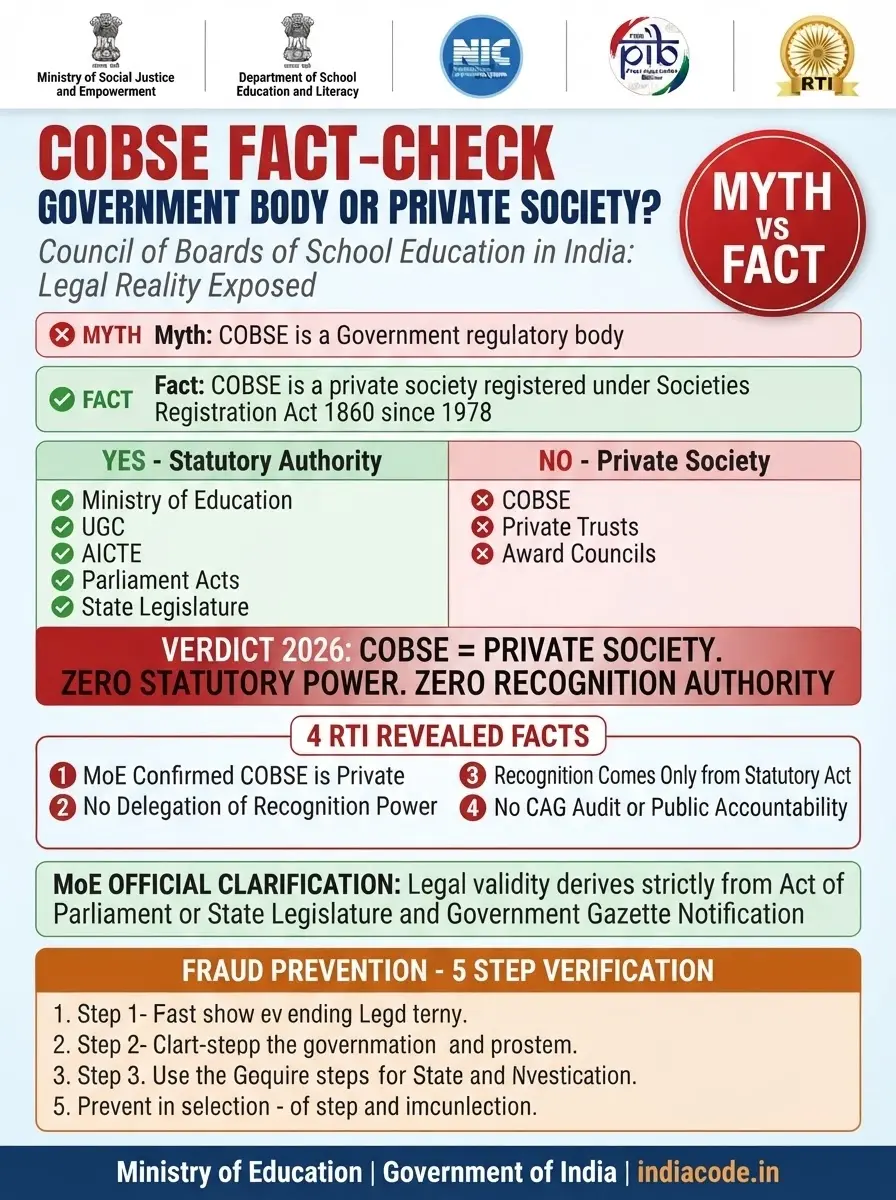
When millions of students, parents, and school administrators search for 'COBSE' on Google, they often assume it is an apex government regulatory authority like UGC, CBSE, AICTE, or the Ministry of Education. Here is the unequivocal legal reality:
2. Statutory Authority vs Private Society: The Constitutional Distinction
To understand why COBSE cannot grant legal recognition to school boards, observe the constitutional comparison below:
|
Entity / Organization |
Legal Classification |
Empowering Law / Act |
Can it Grant Board Recognition? |
|---|---|---|---|
|
Ministry of Education (MoE), Govt of India |
Apex Union Ministry |
Constitution of India / Executive Orders |
YES — Statutory Central Authority |
|
State Legislative Assemblies |
Constitutional Lawmaking Body |
State Legislative Acts |
YES — Creates State Secondary/Sr. Sec Boards |
|
University Grants Commission (UGC) |
Statutory Regulator |
UGC Act, 1956 (Act of Parliament) |
YES — For Universities & Higher Education |
|
COBSE (Council of Boards of School Education) |
Private Voluntary Society |
Societies Registration Act, 1860 (Registration No. S-10116) |
NO — Zero Statutory or Legal Authority |
3. The 1978 to Present Reality: The Lucrative 'Membership' Business Model
Since its establishment in 1978, COBSE has operated as a voluntary club/forum for school examination boards. However, over the past four decades, this operational structure has raised serious public interest questions:
1. Hefty Admission & Annual Subscription Fees:
COBSE charges substantial non-refundable processing fees, entrance fees, and recurring annual subscription fees from boards and educational bodies seeking to get their names listed as 'Members'.
2. The Marketing Illusion of 'COBSE Approved':
Across India, dozens of unapproved private boards, study centres, and touts advertise: 'Our Board is Approved by COBSE, Delhi'. Unaware students and parents fall for this aggressive marketing, paying thousands of rupees for admissions under the false belief that COBSE is an official government accreditor.
3. Lack of Public Audits & Regulatory Accountability:
As a registered society, COBSE does not undergo Comptroller and Auditor General (CAG) parliamentary audits, nor is it accountable under strict public regulatory oversight, despite deeply impacting public educational perceptions.
4. The Administrative Paradox: Why Government Boards in a Private Body Mislead Students
The biggest driver of public deception is the presence of legitimate government boards (like CBSE, NIOS, UPMSP, BSEB, etc.) on COBSE's member roster. This creates an administrative paradox:
5. What the Ministry of Education & RTI Inquiries Officially State
Multiple Right to Information (RTI) applications and queries raised in Parliament have forced the Union Ministry of Education to put the facts on public record:
6. Fraud Prevention Guide: How to Verify Real Govt Boards vs Society Memberships
If an educational board or admission agent claims credibility by showing a 'COBSE Membership Certificate', follow these strict verification steps:
7. Frequently Asked Questions (FAQs) - Everything You Need to Know About COBSE
Q1: Is COBSE a Government Organization or a Private Body?
COBSE is 100% a private voluntary society registered under the Societies Registration Act, 1860. It is NOT a government department, statutory council, or constitutional body.
Q2: Is a board certificate valid for Government Jobs just because it is listed in COBSE?
No. Employment validity for Central Government (UPSC, SSC, Railways, Armed Forces) and State Government jobs requires the board to be created by an Act of Parliament or State Legislature. COBSE membership carries no legal weight in government recruitment.
Q3: Can COBSE approve new Open School Boards in India?
No. COBSE has no legal power to approve or recognize school boards. Any board operating solely on the basis of 'COBSE recognition' without a statutory Act or Government Gazette notification is operating on legally precarious ground.
Q4: Why do private boards show COBSE certificates to students during admission?
Private boards and agents use COBSE membership certificates as a marketing tool to convince unaware students that they have 'National Approval' or 'Delhi Recognition', exploiting the public's lack of legal awareness.
Q5: Which are the genuine Open Boards recognized by the Government?
Legally recognized open schooling boards include NIOS (National Institute of Open Schooling under the Ministry of Education), CBOSE (Central Board of Open Schooling and Examination), and statutory State Open Boards such as BBOSE (Bihar), RSOS (Rajasthan), and MPSOS (Madhya Pradesh).