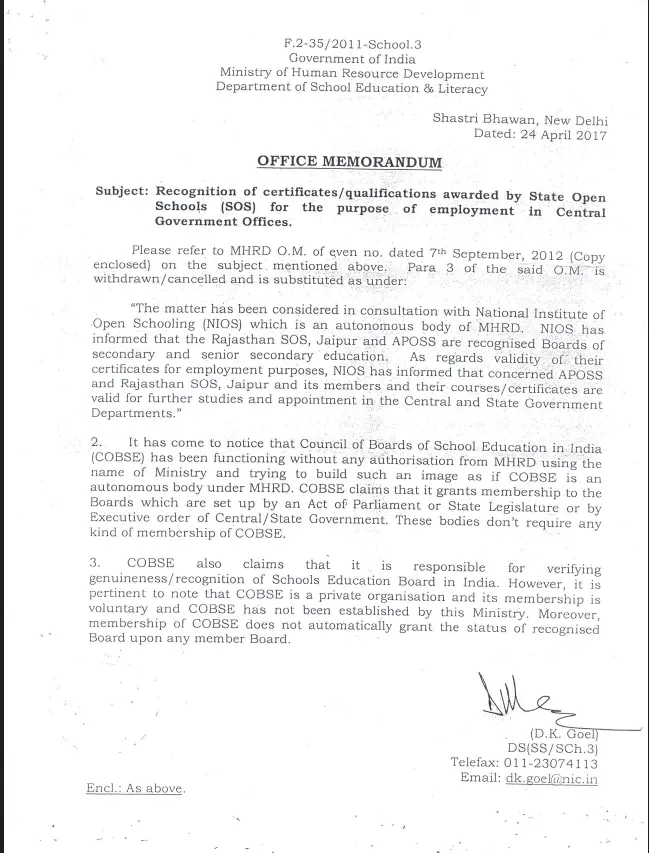
Government of India 2017 Order Clarification: COBSE is Not a Government Body & COBSE Membership is Not Mandatory for Board Recognition
Public Legal Advisory & Regulatory Review: Ministry of Human Resource Development (now Ministry of Education) 2017 Official Clarification on the Status of COBSE (Council of Boards of School Education in India)
Table of Contents
2. Official Findings: What the Government of India Clarified in 2017
3. In-Depth Legal Analysis: Why COBSE is Not a Statutory Regulator
3.1 COBSE is a Registered Society, Not a Regulatory Body
3.2 The Ministry of Education's Stand on COBSE
3.3 Misuse of 'COBSE List' for Misleading Propaganda
4. The True Statutory Pathways of School Board Recognition in India
5. Impact on Public Sector Recruitments & Higher Education Admissions
6. Digital Verification Repositories vs. COBSE Misconceptions
7. Frequently Asked Questions (FAQs)
1. Executive Summary: The 2017 Government Clarification on COBSE
For years, considerable confusion existed among students, parents, school administrators, and job applicants regarding the role and legal authority of the Council of Boards of School Education in India (COBSE). Many unauthorized entities and misleading advisories falsely claimed that 'COBSE membership' or 'COBSE approval' is mandatory for an education board to be recognized in India.
To put an end to this widespread misinformation, the Ministry of Human Resource Development (MHRD, now the Ministry of Education, Government of India) issued clear regulatory orders and RTI clarifications in 2017 establishing the exact legal status of COBSE. This public information advisory outlines the official government position, statutory provisions, and court rulings governing school board recognition in India.
2. Official Findings: What the Government of India Clarified in 2017
The 2017 Government of India communications and Ministry circulars established four fundamental legal determinations:
|
Legal Dimension |
Official Government of India Position |
Statutory Provision / Reference |
Legal Effect |
|---|---|---|---|
|
1. Nature of COBSE |
COBSE is a voluntary, non-governmental private society. |
Societies Registration Act, 1860 (Registration No. S-10700) |
Holds no sovereign or statutory authority of the Union Government. |
|
2. Authority to Grant Recognition |
COBSE has NO power to grant, recognize, or de-recognize any education board. |
Ministry of Education Official Clarification Orders (2017) |
COBSE approval/list is not a legal prerequisite for board validity. |
|
3. Requirement of Membership |
Membership of COBSE is purely voluntary and NOT mandatory under law. |
Government of India Policy Guidelines & Judicial Rulings |
Non-member boards are 100% legally valid if statutorily constituted. |
|
4. Legitimate Recognition Authority |
Recognition lies exclusively with Parliament, State Legislatures, and Gazetted notifications. |
Constitution of India (Entry 25, Concurrent List & Article 200) |
Boards established under statutory acts/gazettes hold full legal validity. |
3. In-Depth Legal Analysis: Why COBSE is Not a Statutory Regulator
3.1 COBSE is a Registered Society, Not a Regulatory Body
COBSE was registered as a society under the Societies Registration Act, XXI of 1860. In Indian administrative jurisprudence, a society registered under the 1860 Act is an autonomous private body. It is not an apex regulatory authority like the University Grants Commission (UGC), All India Council for Technical Education (AICTE), or Medical Counselling Committee (MCC), which are created by specific Acts of Parliament.
3.2 The Ministry of Education's Stand on COBSE
The Central Government (Ministry of Education) has repeatedly clarified through official orders and parliamentary responses that the Government of India does not regulate school boards through COBSE. COBSE acts merely as a voluntary coordination forum for member boards to discuss mutual academic interests, curriculum harmonization, and sports events. It does not possess any statutory mandate under the Delhi School Education Act or any central legislation to approve or license school boards.
3.3 Misuse of 'COBSE List' for Misleading Propaganda
In several instances, commercial intermediaries have falsely advertised that an educational board is 'fake' simply because its name does not appear on the COBSE member list, or that an education board is 'government-approved' solely because it paid membership fees to COBSE. The 2017 Government clarification conclusively establishes that COBSE membership is entirely voluntary and is neither a test nor a proof of government approval.
4. The True Statutory Pathways of School Board Recognition in India
In accordance with Entry 25 of the Concurrent List (Seventh Schedule of the Constitution of India), an education board in India derives legitimate recognition through genuine statutory and constitutional channels:
|
Recognition Channel |
Governing Legal Instrument |
Representative Examples |
|---|---|---|
|
Central Government Boards |
Executive Resolution / Central Act of Parliament |
CBSE (Central Board of Secondary Education), NIOS (National Institute of Open Schooling) |
|
State Legislative Boards |
State Madhyamik / Higher Secondary Education Acts |
UPMSP (UP Board), MSBSHSE (Maharashtra), BSEB (Bihar), GSEB (Gujarat) |
|
Autonomous Gazetted Boards |
Societies Registration Act 1860 + Official Gazette Notification + Article 200 Assent |
CBOSE (UP Gazette Notification No. 500/79-V-1-21-2(Ka)-22-2018, Art. 200 Governor's Assent, cbose.com), CISCE (ICSE/ISC) |
5. Impact on Public Sector Recruitments & Higher Education Admissions
A crucial consequence of the 2017 Government clarification is that recruiting agencies and universities cannot reject a candidate's marksheet merely on the grounds that the issuing board is not a member of COBSE:
6. Digital Verification Repositories vs. COBSE Misconceptions
Rather than relying on non-statutory association lists, modern educational transparency relies on transparent 24x7 online marksheet verification maintained directly by legitimate boards:
|
Board Name |
Statutory Foundation |
Official Verification Portal |
|---|---|---|
|
CBSE |
Autonomous body under Ministry of Education (GoI) |
cbse.gov.in / DigiLocker |
|
CBOSE |
Societies Act 1860 + UP Gazette 2018 (Art. 200 Assent) |
cbose.com/student/login.php |
|
NIOS |
Autonomous institution under Ministry of Education (GoI) |
sdmis.nios.ac.in |
|
State Boards (UPMSP, etc.) |
State Secondary Education Acts |
upmsp.edu.in / Respective State Portals |
7. Frequently Asked Questions (FAQs)
Q1. Is COBSE a Government of India organization?
No. COBSE (Council of Boards of School Education in India) is a private voluntary society registered under the Societies Registration Act, 1860. It is NOT a government body, nor is it a wing of the Ministry of Education.
Q2. Is COBSE membership mandatory for an education board to be recognized in India?
No. The Government of India has officially clarified in 2017 that COBSE membership is purely voluntary. An education board does NOT need COBSE membership to be recognized, valid, or authorized to conduct examinations.
Q3. Can COBSE approve, recognize, or cancel an education board?
No. COBSE has no legal power or statutory authority under Indian law to grant recognition, equivalence, or affiliation to any school board. Recognition is governed exclusively by Parliament, State Legislatures, and Official Government Gazette notifications.
Q4. Are certificates from non-COBSE member boards valid for Govt Jobs (GDS, SSC, Railways) and NEET/JEE?
Yes. As long as the board is established under an Act of Parliament, a State Legislative Act, or registered with an Official Government Gazette Notification (such as CBOSE with UP Gazette 2018 and Article 200 Assent), its certificates are 100% valid for government recruitments and college admissions.
Q5. What is the real benchmark for verifying a board's authenticity?
The authentic benchmarks are: (1) Statutory Enactment or Society Registration under law, (2) Official Government Gazette Notification, (3) Constitutional Assent under Article 200, and (4) 24x7 Digital Marksheet Verification on the board's official portal (e.g., cbose.com/student/login.php).
8. Conclusion & Public Advisory
The 2017 Government of India clarification serves as an authoritative public notice dismantling the myth of mandatory COBSE membership. Students, educational institutions, and recruitment authorities are advised to evaluate educational boards based on true constitutional and statutory credentials—including Legislative Acts, Official Gazette Notifications, and digital verification infrastructure—rather than private voluntary society listings.