COBSE Reality & Legal Status: An In-Depth Investigative Analysis of Private Association Memberships, Education Governance, and Statutory Recognition in India
Comprehensive Legal & Administrative Breakdown: What Is COBSE, The Question of Statutory Recognition, Why Private Society Memberships Create Public Confusion, and The Legal Framework of Government School Boards
1. Executive Summary: The Debate Surrounding COBSE in Indian Education
For decades, the name 'COBSE' (Council of Boards of School Education in India) has been widely circulated across educational institutions, school administration desks, and admission forums. Many students, parents, and private educational entrepreneurs assume that COBSE is an official statutory regulator—akin to the University Grants Commission (UGC), All India Council for Technical Education (AICTE), or National Council for Teacher Education (NCTE). However, a deep legal and administrative examination reveals a starkly different constitutional and regulatory reality.
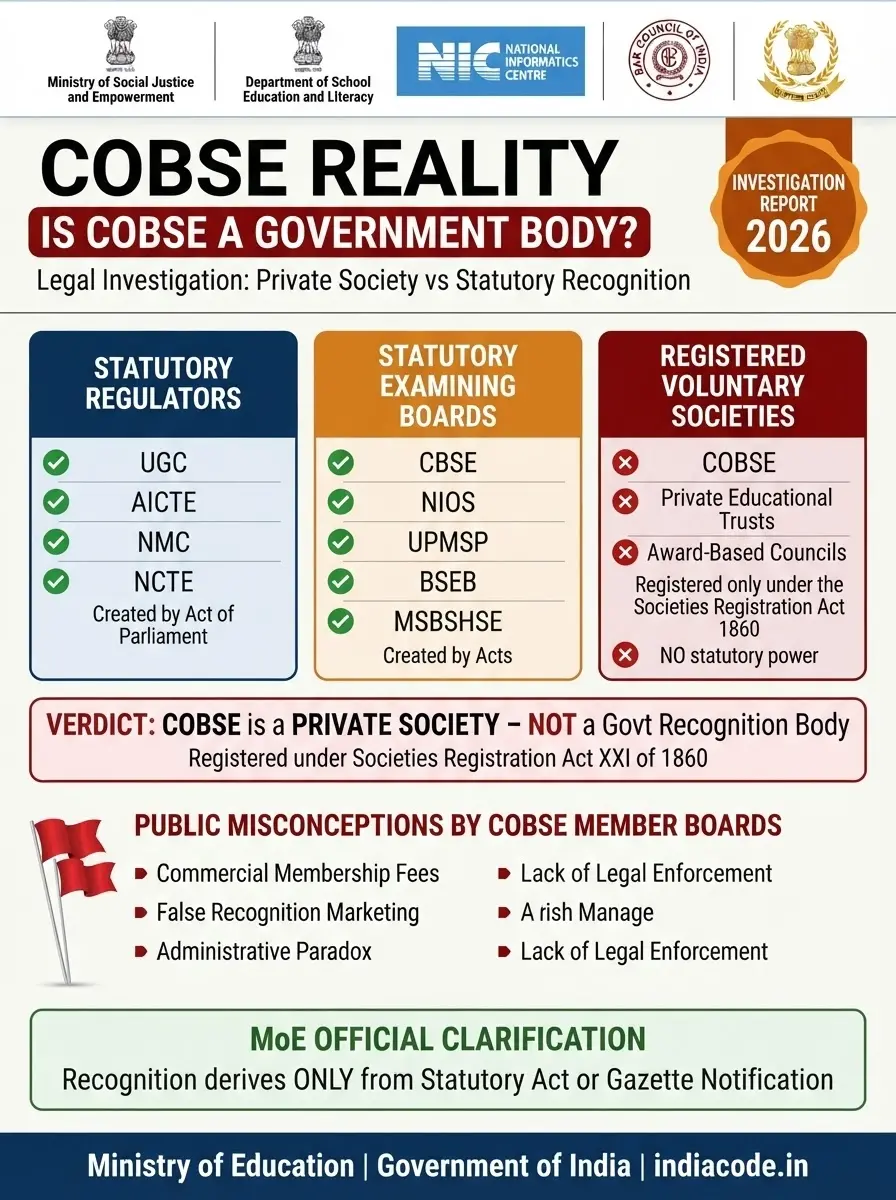
Established in 1978 and registered as a voluntary society under the Societies Registration Act XXI of 1860, COBSE is a non-governmental voluntary association rather than a statutory body enacted by an Act of Parliament. This crucial distinction has ignited intense debate among legal scholars, RTI activists, and educationists regarding the role of private associations in the public schooling ecosystem, the collection of membership fees, and the widespread misconceptions generated among students.
2. What Exactly Is COBSE? The Legal & Constitutional Classification
To understand the controversy, one must evaluate the statutory definition of an educational authority in India under the Constitution and Administrative Law:
|
Entity Type |
Legal Basis / Enactment |
Statutory Power to Grant Recognition |
Examples in India |
|---|---|---|---|
|
Statutory Regulator |
Created by Act of Parliament |
YES — Legally empowered to grant, regulate & derecognize institutions |
UGC, AICTE, NMC, NCTE, BCI, PCI |
|
Statutory Examining Board |
Created by Act of Parliament / State Legislature |
YES — Authorized to conduct public exams & award valid 10th/12th certificates |
CBSE, NIOS, UPMSP, BSEB, MSBSHSE, etc. |
|
Registered Voluntary Society (e.g., COBSE) |
Registered under Societies Registration Act, 1860 |
NO — Cannot grant legal recognition, statutory equivalence, or license to operate |
Voluntary Associations, Non-Governmental Forums, Educational Societies |
Key Legal Finding: A society registered under the Societies Registration Act, 1860 is purely a private voluntary body. It does not possess constitutional, legislative, or executive authority to confer legal recognition upon any school board or validate examination certificates.
3. The Membership Model: Financial & Administrative Scrutiny
Since its inception in 1978, COBSE has operated as a voluntary forum where various secondary and higher secondary education boards enrolled as member boards. Over the years, significant questions have been raised regarding this operational structure:
1. Substantial Annual & Lifetime Membership Fees:
Boards and participating entities pay substantial entrance fees, annual subscriptions, and processing charges to gain and maintain 'membership' status. Critics argue that this commercial membership mechanism operates without public accountability or state-audited regulatory oversight.
2. The 'Recognition' Illusion Created for Common Students:
Because many statutory government boards are listed as members alongside non-statutory or private bodies, unverified marketing campaigns frequently misrepresent 'COBSE Membership' as 'Government of India Approval' or 'Official Equivalence'. This creates massive confusion among students who mistakenly believe that being listed on a private society's website automatically makes a certificate legally binding.
3. Lack of Legal Enforcement Authority:
Unlike the UGC or Ministry of Education, COBSE has no legal enforcement wing, investigating officers, or statutory tribunal to regulate educational standards, penalize corrupt practices, or safeguard student consumer rights.
4. The Administrative Paradox: Statutory Boards as Members of a Private Society
One of the sharpest administrative dilemmas raised in legal and bureaucratic circles concerns the participation of statutory government boards in a private voluntary association:
Administrative Code & Civil Service Precedents:
Under Central and State Civil Services Conduct Rules, government departments and public statutory officers are strictly prohibited from utilizing their official positions to grant unwarranted legitimacy to private societies, trusts, or non-statutory associations.
How Did Statutory Boards Become Members?
Historically, statutory state boards joined COBSE simply as an informal discussion platform to exchange examination formats and discuss curriculum reforms. However, over time, this informal relationship was commercialized and weaponized by private entities to falsely portray COBSE as the supreme accrediting agency for school boards in India.
The Conflict of Public Interest:
When a constitutional or statutory board (created by an Act of Legislature) sits as a paid member in a private society, it blurs the line between public governance and private commercial interests, exposing vulnerable students to fraudulent claims by unauthorized operators.
5. Ministry of Education (Govt. of India) Clarifications & Stance
In response to multiple Parliamentary questions (Lok Sabha & Rajya Sabha) and Right to Information (RTI) queries, the Ministry of Education (formerly MHRD), Government of India, has repeatedly clarified the legal position:
6. True Legal Criteria: How Genuine Boards Derive Statutory Authority
Under Indian Law and Supreme Court precedents, a secondary or senior secondary certificate is legally valid for UPSC, SSC, NEET, JEE, CUET, Defence recruitment, and university admissions ONLY if it satisfies genuine statutory standards:
|
Statutory Pillar |
Legal Requirement & Authority |
Verification Evidence |
|---|---|---|
|
Central Statutory Act |
Enacted by an Act of Parliament or Central Ministry Order |
Gazette of India Notification (e.g., CBSE, NIOS) |
|
State Legislative Act |
Passed by State Legislative Assembly & Assented by Governor |
State Government Gazette Notification (e.g., UPMSP, BSEB, RBSE) |
|
University Equivalence |
Recognized by Association of Indian Universities (AIU) / UGC |
AIU Equivalence Directory & University Academic Councils |
|
Autonomous National Open Schooling |
Established under legitimate Open Schooling & Skill Frameworks |
Direct Public Verification Portals, NCF Compliance & State NOCs |
7. Impact on Students: Why You Must Look Beyond 'Society Memberships'
Students and parents must exercise extreme caution when evaluating school boards and open schooling institutions:
8. Frequently Asked Questions (FAQs) - COBSE Legal Status & Board Recognition
Q1: Is COBSE a Government organization or a statutory body in India?
No. COBSE (Council of Boards of School Education in India) is a voluntary society registered under the Societies Registration Act, 1860. It is not a statutory body created by an Act of Parliament and does not have the legal authority to grant government recognition to school boards.
Q2: Does COBSE membership guarantee that a 10th or 12th certificate is valid for Government Jobs?
No. Employment validity for Central Government (UPSC, SSC, Defence, Railways) and State Government jobs depends strictly on whether the board was established by an Act of Parliament, State Legislature, or recognized by the Ministry of Education—not on membership in COBSE.
Q3: Can a private society grant official 'Equivalence' between educational boards?
No. In India, legal equivalence for university admissions and academic mobility is determined by statutory universities, the Association of Indian Universities (AIU), and State/Central Education Departments, not by private societies.
Q4: Why do government boards participate as members in COBSE?
Government boards historically joined COBSE as an informal collaborative platform to discuss curriculum reforms, mutual exam formats, and share academic insights. However, this membership does not transform the private society into a government regulatory authority.
Q5: What should students verify before taking admission in an Open Board?
Students must verify that the open board is statutory (such as NIOS or State Open Boards like BBOSE, RSOS, MPSOS) or operates under recognized National Curriculum and Skill Frameworks with verified digital verification and AIU/Higher Education acceptance.
9. Conclusion: The Urgent Need for Transparent Educational Governance
The ongoing debate regarding COBSE highlights the critical necessity for transparency, public accountability, and clear statutory guidelines in Indian school education. While voluntary educational forums can serve as constructive discussion platforms, conflating private society memberships with statutory government recognition harms millions of students and clouds the educational landscape.
The Ministry of Education and state regulatory authorities must step forward to issue definitive guidelines, ensuring that students are not misled by ambiguous accreditation claims. At India Code (indiacode.in), we remain committed to delivering unbiased, legally grounded, and transparent insights into India's educational laws, statutory frameworks, and public governance.