Exposing 46+ Years of COBSE Misinformation: How a Private Association Misled the Public Through Thousands of Websites & Why MHRD Issued its 2017 Public Alert
An Investigative Fact-Check on the Council of Boards of School Education in India (COBSE) — Private Voluntary Society Registration (1860 Act), Misleading Digital Ecosystems, and the Official Ministry of Education 2017 De-Linking Directive
Table of Contents
2. Chronology: From Private Forum to MHRD's 2017 Public Alert
3. The Machinery of Misinformation: Thousands of Misleading Websites
3.1 Keyword Manipulation on Search Engines
3.2 Exploiting the Name 'Council' to Impersonate Government Bodies
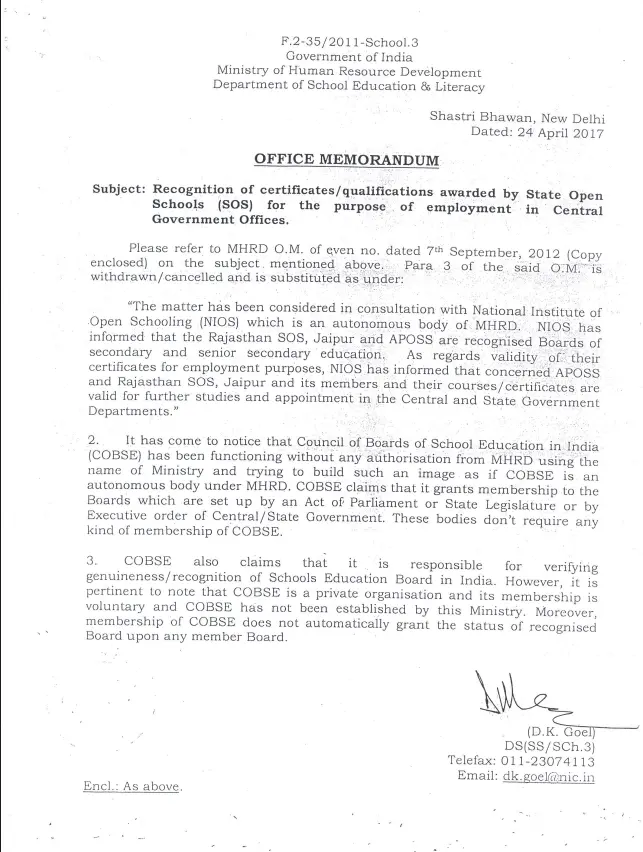
4. The MHRD 2017 Official Clarification: Shattering the Monopoly
5. Constitutional Truth: How School Boards Derive Genuine Recognition
6. Public Advisory: How to Avoid the COBSE Misinformation Trap
7. Frequently Asked Questions (Public Awareness FAQs)
1. Introduction: Deconstructing the 46-Year-Old COBSE Illusion
For over four and a half decades—since its inception in 1979—a private registered society known as the Council of Boards of School Education in India (COBSE) has managed to project an illusion of sovereign regulatory authority across India's educational landscape. Through an intricate web of thousands of unverified websites, coaching blogs, and unauthorized circulars, the public has been misled into believing that COBSE is the apex government recognizing body for school education boards.
The stark legal and statutory reality is that COBSE is ONLY a private voluntary association registered under the Societies Registration Act, 1860. It possesses no legislative mandate, no regulatory authority from Parliament, and no power to grant, withhold, or cancel the recognition of any educational board in India.
2. Chronology: From Private Forum to MHRD's 2017 Public Alert
The historical timeline below illustrates how a voluntary society evolved into a source of widespread public confusion, eventually prompting the Central Government to issue its landmark 2017 clarification:
|
Period / Milestone |
Historical Event / Action |
Legal & Public Reality |
|---|---|---|
|
1979 |
Establishment of COBSE |
Registered under the Societies Registration Act, XXI of 1860 as a voluntary coordination club for participating boards. |
|
1980s – 2000s |
Creeping Misrepresentation |
Began marketing itself as an accrediting umbrella body; charging institutional subscriptions to sovereign state boards. |
|
2000s – 2016 |
Proliferation of Misleading Websites |
Thousands of educational portals and touts spread the false narrative that non-COBSE boards are invalid. |
|
2017 |
MHRD (Ministry of Education) Official Order |
Government of India officially clarified that COBSE is a private society with ZERO regulatory authority over boards. |
|
Present Day |
Continuing Public Vigilance |
High Courts and administrative authorities actively reject attempts to treat COBSE membership as a legal prerequisite. |
3. The Machinery of Misinformation: Thousands of Misleading Websites
The 46-year deception was sustained primarily through a coordinated digital echo chamber. An analysis of this digital manipulation reveals:
3.1 Keyword Manipulation on Search Engines
Commercial admission consultants, unverified wiki portals, and fake board aggregators heavily targeted keywords like 'Recognized Board List in India' and 'Approved School Boards', deliberately redirecting search engine traffic to COBSE's private membership list. This created an artificial perception that any board not paying fees to COBSE was unapproved.
3.2 Exploiting the Name 'Council' to Impersonate Government Bodies
By adopting the nomenclature 'Council of Boards of School Education in India', the private society created confusion with statutory apex councils such as the University Grants Commission (UGC), Medical Council of India (MCI/NMC), and All India Council for Technical Education (AICTE). Unlike these statutory councils created by Acts of Parliament, COBSE is merely a registered society under the 1860 Act.
4. The MHRD 2017 Official Clarification: Shattering the Monopoly
In 2017, the Ministry of Human Resource Development (now Ministry of Education, Government of India) intervened to protect students and statutory institutions from continuing exploitation. The key findings of the Government's 2017 position are:
|
Government Determination |
Statutory Provision / Finding |
Operational Consequence |
|---|---|---|
|
1. Private Entity Status |
Registered Society under Act XXI of 1860 |
Holds zero sovereign, statutory, or regulatory authority of the Union Government. |
|
2. No Licensing Authority |
Absence of Parliamentary Act or Delegation |
Cannot grant equivalence, recognition, affiliation, or licenses to school boards. |
|
3. Membership Not Mandatory |
Voluntary Private Association Framework |
No educational board in India is required by law to join or pay fees to COBSE. |
|
4. Legal Immunity of Non-Members |
Constitutional Federalism (Entry 25, List III) |
Non-member statutory boards enjoy full legal recognition across all government recruitments and universities. |
5. Constitutional Truth: How School Boards Derive Genuine Recognition
Under the Indian Constitution, the power to create and recognize educational boards belongs exclusively to sovereign legislative bodies, operating under three legitimate pathways:
6. Public Advisory: How to Avoid the COBSE Misinformation Trap
To counter the 46-year legacy of confusion, stakeholders must adhere to the following verification principles:
7. Frequently Asked Questions (Public Awareness FAQs)
Q1. What is the real legal status of COBSE in India?
COBSE is ONLY a private voluntary society registered under the Societies Registration Act, 1860. It is NOT a government body, regulatory authority, or government recognizing agency.
Q2. How has COBSE misled the public for nearly 46 years?
By utilizing the deceptive title 'Council' and leveraging thousands of unverified online blogs, COBSE created a false impression of being a mandatory government accreditation body, coercing state boards into paying subscriptions and misleading students.
Q3. What did the MHRD (Ministry of Education) clarify in 2017?
The Ministry of Education officially clarified in 2017 that COBSE is a private society with no power to recognize, affiliate, or de-recognize educational boards, and that COBSE membership is 100% voluntary.
Q4. Can a student's marksheet be rejected if the issuing board is not in COBSE?
No. Any rejection based on lack of COBSE membership is illegal and unconstitutional. Marks awarded by statutorily established or gazette-notified boards are universally valid across all universities and government recruitments (GDS, SSC, Railways, Defence).
Q5. Where does authentic recognition for an educational board come from?
Authentic recognition comes from Acts of Parliament, State Legislative Acts, or statutory registrations backed by Official Government Gazette Notifications and Article 200 Constitutional Assent.
8. Conclusion: End of the 46-Year Deception
The myth of COBSE as a mandatory educational regulator has been definitively dismantled by constitutional law, official MHRD directives, and judicial rulings. Educational boards, public servants, and students must look beyond private association listings and ground their understanding in the true sovereign statutes and official gazettes of the Republic of India.