Open Board Admission 2026-27: October & November Cycle Online Registration for 10th & 12th (NIOS, CBOSE, BBOSE, RSOS, MPSOS & National/State Open Boards)
Comprehensive Guide for Students: Eligibility, Dates, Fees, Subject Choice, ODE, and High-Ranking National & State Open School Boards in India
1. Introduction: Open Schooling in India (2026-27 Session)
Open and Distance Learning (ODL) at the secondary (Class 10) and senior secondary (Class 12) levels has emerged as a powerhouse for flexible and accessible education across India. For students who could not complete their regular schooling due to personal reasons, sports commitments, competitive exam preparation (JEE/NEET/UPSC Foundation), or those seeking a second chance after failing in regular state/central boards (CBSE, ICSE), Open School Boards offer a recognized, affordable, and legally valid alternative.
For the academic cycle 2026-27, admissions are officially open across major National and State Open Schooling Boards—including NIOS, CBOSE (Central Board of Open Schooling and Examination), BBOSE, RSOS, and MPSOS—for the upcoming October/November examination cycle (also known as Stream-1 Block-2 / Secondary & Sr. Secondary Phase-II). Certificates issued by recognized open boards have equal legal validity to CBSE/CISCE for higher education (college/university admissions, CUET, NEET, JEE) and government/private sector employment.
Key Highlights: Open Board Admissions (Oct/Nov Cycle 2026-27)
|
Particulars |
Details & Specifications |
|---|---|
|
Academic Year |
2026-2027 |
|
Admission Cycle |
October / November Examination Cycle (Block 2 / Phase II) |
|
Target Classes |
Class 10th (Secondary) & Class 12th (Senior Secondary) |
|
Major Boards Covered |
NIOS, CBOSE, BBOSE, RSOS, MPSOS, WBCROS, APOSS/TOSS |
|
Mode of Application |
100% Online Registration & Document Verification |
|
Recognized By / Affiliations |
Ministry of Education (MoE), COBSE, UGC, AIU, AICTE, MHRD guidelines |
|
Special Facilities |
TOC (Transfer of Credit), On-Demand Exams (ODE), Part Admission, Skill Subjects |
|
Official Portal & Guidance |
Respective Board Portals & Live Updates on India Code (indiacode.in) |
2. Top National & Recognized State Open Boards in India
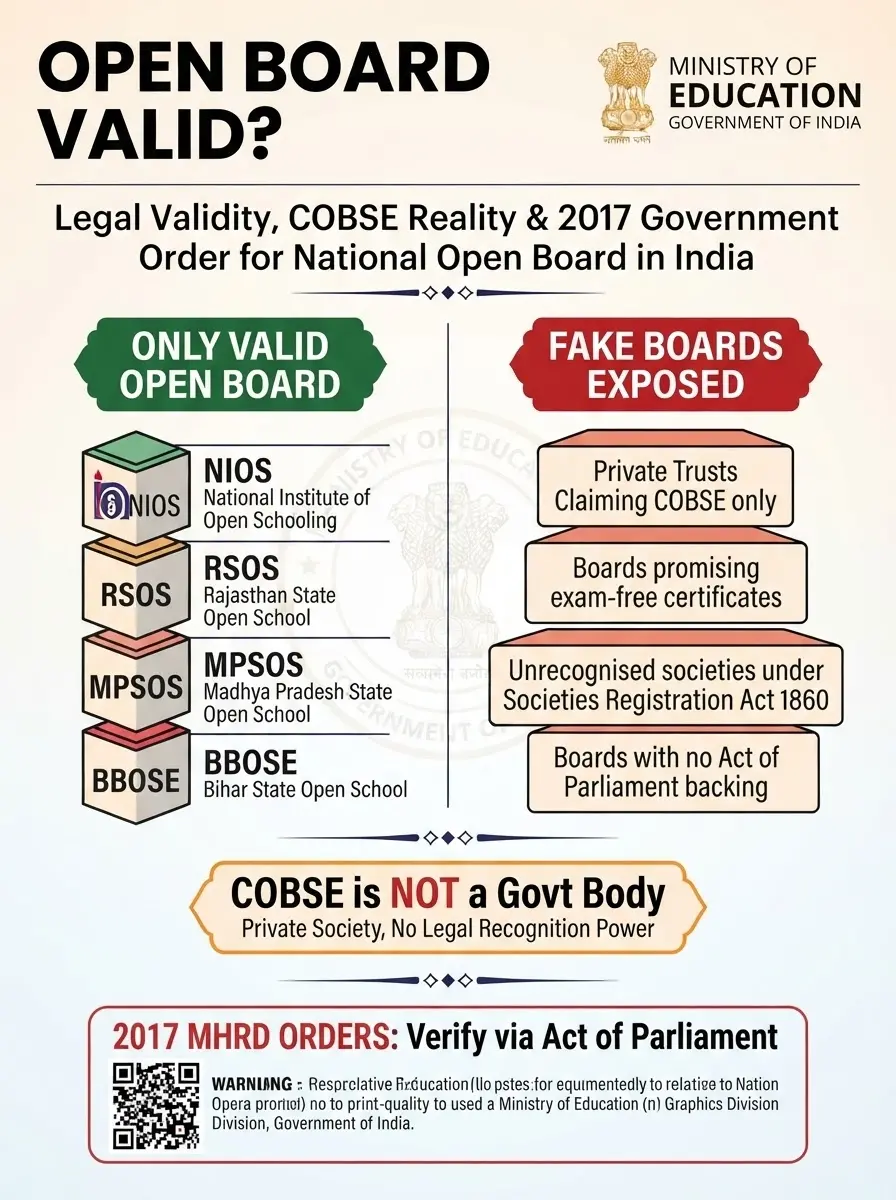
When selecting an Open Board, students and parents must ensure that the board is legally recognized, registered, and adheres to national open schooling benchmarks. Below are the leading national and state-level open schooling boards offering admission for the 2026-27 October/November cycle:
|
Board Name |
Type & Reach |
Recognition / Pattern |
Official Website / Portal |
|---|---|---|---|
|
National Institute of Open Schooling (NIOS) |
National (All India & Overseas) |
Autonomous Institution under Ministry of Education, Govt. of India |
sdmis.nios.ac.in |
|
CBOSE (Central Board of Open Schooling & Examination) |
National / Pan-India Open Board |
Open Schooling System following National Curriculum & Skill Standards |
cbose.edu.in / official portal |
|
Bihar Board of Open Schooling (BBOSE) |
State Open Board (Bihar) |
Recognized by Govt. of Bihar & COBSE Member |
bbose.org.in |
|
Rajasthan State Open School (RSOS) |
State Open Board (Rajasthan) |
Recognized by Govt. of Rajasthan & COBSE Member |
rsosapp.rajasthan.gov.in |
|
Madhya Pradesh State Open School (MPSOS) |
State Open Board (MP) |
Recognized by Govt. of MP & COBSE Member |
mpsos.nic.in |
|
West Bengal Council of Rabindra Open Schooling (WBCROS) |
State Open Board (WB) |
Statutory Body under School Education Dept., WB |
wbrosonline.gov.in |
|
Andhra Pradesh / Telangana Open School Society (APOSS/TOSS) |
State Open Board (South) |
Recognized by State Govts & COBSE Members |
apopenschool.ap.gov.in |
3. Featured Focus: CBOSE (Central Board of Open Schooling and Examination)
The Central Board of Open Schooling and Examination (CBOSE) has gained significant prominence as a flexible national-level open schooling platform designed to bridge educational gaps for diverse learner groups. CBOSE caters specifically to students requiring modern digital learning support, fast-track examination options, vocational integration, and nationwide examination center accessibility.
Salient Features of CBOSE Admission (2026-27 October/November Cycle):
4. NIOS Admission 2026-27 (Block-2 October/November Exam Cycle)
The National Institute of Open Schooling (NIOS) conducts public examinations twice a year: Block-1 (April/May) and Block-2 (October/November). Candidates aiming for the Oct/Nov 2026-27 cycle should adhere to the following schedule:
Important Admission Timeline for NIOS & National Open Boards (Block-2):
5. Eligibility Criteria for 10th & 12th Open Board Admissions (NIOS, CBOSE, State Boards)
For Class 10th (Secondary Course):
For Class 12th (Senior Secondary Course):
6. Unique Advantages & Special Provisions of Open Schooling
National and State Open Boards provide innovative facilities tailored for non-traditional students:
1. Transfer of Credit (TOC):
Students who could not pass regular boards (CBSE, CISCE, State Boards) can transfer marks of up to 2 passed subjects to Open Boards (such as NIOS, CBOSE, BBOSE, RSOS), appearing only in the remaining 3 subjects to complete their secondary or senior secondary certificate.
2. Dual Enrollment & Part Admission:
Regular school students can take 1 or 2 specialized subjects (e.g., Computer Science, Data Entry, Vocational Courses, Fine Arts) from Open Boards alongside regular schooling.
3. Flexible Examination Scheme & On-Demand Examination (ODE):
In addition to the biannual October/November public exams, students can opt for On-Demand Examinations or special modular test cycles when they feel fully prepared.
4. Subject Flexibility (No Rigid Stream System):
Students can freely combine Science, Commerce, and Humanities subjects (e.g., Physics, History, Accountancy, Computer Science, and English) without traditional stream restrictions.
7. General Fee Structure & Subject Schemes (Indicative for 2026-27)
|
Course Level |
General Category (Male) |
Exempted / Female / SC / ST / PwD |
Additional / TOC Subject Fee |
|---|---|---|---|
|
Secondary (10th) - 5 Subjects |
Rs. 1,800 - 2,400 |
Rs. 1,450 - 1,800 |
Rs. 400 - 650 per subject |
|
Sr. Secondary (12th) - 5 Subjects |
Rs. 2,000 - 2,800 |
Rs. 1,650 - 2,200 |
Rs. 450 - 750 per subject |
|
Practical Exam Fee |
Rs. 150 - 350 / subject |
Rs. 150 - 350 / subject |
Applicable where lab work is involved |
|
Examination Fee (Public) |
Rs. 250 - 450 / subject |
Rs. 250 - 450 / subject |
Paid separately before exam window |
8. Step-by-Step Guide: How to Apply Online for Open Board Admission 2026-27
9. Required Documents Checklist for Online Registration
10. Frequently Asked Questions (FAQs) - National & State Open Boards (NIOS, CBOSE & Others)
Q1: Is an Open Board (NIOS / CBOSE / State Boards) 10th and 12th certificate valid for Government Jobs and UPSC/SSC exams?
Yes. Certificates issued by NIOS, CBOSE, and recognized State Open Boards that follow national curriculum norms are valid for all central and state government recruitment, UPSC Civil Services, SSC, Indian Railways, Armed Forces, Banking, and Police examinations.
Q2: Can Open Board students appear for National Entrance Exams like NEET, JEE Main, and CUET?
Yes. The National Testing Agency (NTA) and National Medical Commission (NMC) allow open school candidates who have completed 12th with mandatory required subjects (Physics, Chemistry, Biology/Mathematics) and requisite passing marks to appear for NEET-UG, JEE Main/Advanced, and CUET-UG.
Q3: What role does CBOSE (Central Board of Open Schooling and Examination) play for open board aspirants?
CBOSE provides a student-centric, digital-friendly open schooling framework with comprehensive vocational integration, nationwide examination center availability, and fast-track evaluation options for secondary and senior secondary students.
Q4: What is the minimum passing percentage in Open Boards?
To pass secondary (10th) and senior secondary (12th), a candidate must score a minimum of 33% marks in aggregate as well as in theory and practicals separately in each of the 5 subjects including at least one language.
Q5: How can I apply for Transfer of Credit (TOC) in Open Board?
During online registration, choose the TOC option, enter your previous board details and roll number, and submit your original failed marksheet along with online application copy to the regional center within the prescribed deadline.
11. Conclusion & Guidance for 2026-27 Aspirants
Open Board admission for the 2026-27 October/November cycle is an invaluable gateway for learners seeking flexibility, career enhancement, and seamless educational continuity. Whether enrolling through NIOS, CBOSE (Central Board of Open Schooling and Examination), or State Open Boards (BBOSE, RSOS, MPSOS), students gain the freedom to learn at their own pace without sacrificing recognized academic credentials.
Stay tuned to India Code (indiacode.in) for real-time notifications, direct registration links, CBOSE & NIOS exam date sheets, syllabus updates, study materials, and result announcements for all National and State Open Schooling Boards.