Exposing COBSE Fake Claims: Why COBSE is Not a Government Body & What Students and Parents Must Know
Public Awareness Advisory: Debunking Misleading Propaganda, Exposing Unofficial Accreditation Myths, and Explaining Real Legal Pathways of School Board Recognition in India
Table of Contents
2. Myth vs. Reality: Debunking Top 5 COBSE Propaganda Claims
3. The 2017 Government Order: Official Expose of COBSE Status
4. The 4 Genuine Pillars of School Board Recognition
5. Real-World Impact: College Admissions & Government Jobs
6. Actionable Safety Checklist for Parents and Students
7. Frequently Asked Questions (Awareness FAQs)
1. Introduction: The Growing Trap of COBSE Misinformation
Across India, thousands of students, parents, and coaching counselors fall prey every year to misleading marketing and unverified internet rumors concerning the Council of Boards of School Education in India (COBSE). Many unscrupulous middlemen and private touts spread false claims that unless a school board's name appears on COBSE's website, its certificates are invalid for college admissions and government jobs.
This widespread deception has caused immense distress to genuine students seeking higher education (NEET, JEE, CUET, University degrees) and government jobs (India Post GDS, SSC, Railways, Defence, Police). This public advisory provides an unvarnished factual breakdown of COBSE's true legal nature, official Government of India orders, and the actual constitutional standards for board validity.
2. Myth vs. Reality: Debunking Top 5 COBSE Propaganda Claims
The table below contrasts the common fake narratives spread in the education sector against verified statutory reality:
|
Common Fake Claim (Myth) |
Verified Legal & Government Reality |
Statutory Source / Evidence |
|---|---|---|
|
Myth 1: 'COBSE is a Govt of India recognizing authority like UGC or AICTE.' |
REALITY: COBSE is a private registered society, not a statutory authority created by Parliament. |
Societies Registration Act, 1860 (Reg No. S-10700) |
|
Myth 2: 'COBSE membership is compulsory for school boards in India.' |
REALITY: Membership is purely voluntary. Government of India confirmed it is NOT mandatory. |
Ministry of Education (MHRD) Official 2017 Clarification |
|
Myth 3: 'If a board is not in COBSE list, its marksheet is fake.' |
REALITY: False. Boards established under State Acts, Central orders, or Gazettes |
Constitution of India |
|
Myth 4: 'COBSE has the power to cancel or ban an education board.' |
REALITY: COBSE has zero legal authority to approve, regulate, or cancel any educational board. |
Indian Administrative Law & High Court Precedents |
|
Myth 5: 'Govt jobs (GDS, SSC, Army) reject non-COBSE board candidates.' |
REALITY: Recruitment rules require passing from a recognized board; they do NOT demand COBSE affiliation. |
India Post, SSC & UPSC Official Notification Guidelines |
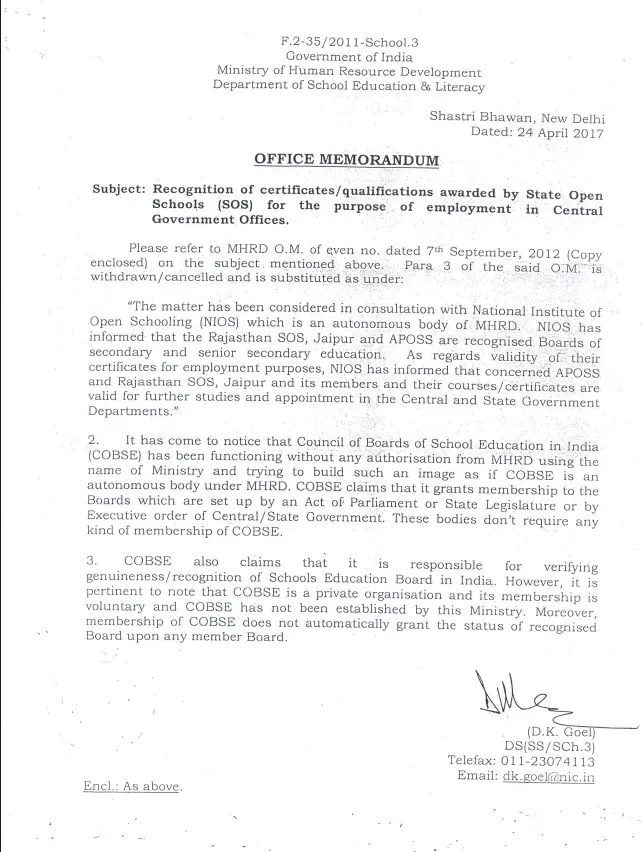
3. The 2017 Government Order: Official Expose of COBSE Status
In 2017, following multiple public grievances and Right to Information (RTI) inquiries, the Central Government (Ministry of Human Resource Development, now Ministry of Education) issued definitive public communications clarifying:
4. The 4 Genuine Pillars of School Board Recognition
Instead of looking for private society memberships, students and parents must verify an educational board based on the following four authentic legal pillars:
|
Legal Benchmark |
What Parents & Students Must Check |
Practical Example / Reference |
|---|---|---|
|
1. Statutory Registration / Enactment |
Check whether the board is established under a Central/State Act or registered under the Societies Act 1860. |
Societies Registration Act 1860 |
|
2. Official Government Gazette |
Verify publication in the Official Central or State Government Gazette. |
Gazette Notification |
|
3. Constitutional Assent |
Confirm executive/legislative Constitution of India. |
Article 200 Governor's Assent (ensures inter-state admissibility) |
|
4. Transparent Online Verification |
Ensure the board operates a 24x7 public digital candidate verification portal. |
student/login (Instant Roll Number & Marksheet Verification) |
5. Real-World Impact: College Admissions & Government Jobs
Students holding marksheets from legally constituted autonomous boards like CBOSE or state boards face NO legal barrier in public employment and university admissions:
6. Actionable Safety Checklist for Parents and Students
Before enrolling in any open school or secondary education board, follow these essential safety steps:
7. Frequently Asked Questions (Awareness FAQs)
Q1. Why are some people claiming that non-COBSE boards are invalid?
This is a common marketing gimmick and false propaganda spread by uninformed agents. The Government of India has officially clarified in 2017 that COBSE is a private voluntary society with no legal power over school board recognition.
Q2. Is COBSE a government organization?
No. COBSE is a non-governmental private society registered under the Societies Registration Act, 1860. It is NOT a government body and does not represent the Ministry of Education.
Q3. Can an employer or college reject a marksheet because the board is not in COBSE?
No. Legally, no government department (like India Post, SSC, Railways, UPSC) or university can reject a marksheet on the basis of COBSE non-membership. Requisite validity comes from statutory acts, gazette notifications, and online verification.
8. Conclusion & Public Advisory
Students and parents must base their educational choices on statutory truth, constitutional law, and official Government of India gazettes rather than misleading rumors about private society memberships. With genuine legal registration, official gazetted notifications, and robust online verification systems, legitimate educational boards.