Recognized Board List in India: Debunking the COBSE Verification Myth & Complete Directory of Genuine Boards
Comprehensive Regulatory Advisory: Why COBSE List is NOT the Legal Benchmark of School Board Recognition in India and How to Verify Genuine Central, State & Statutory Boards
Table of Contents
2. Fact-Check: COBSE Directory vs. True Legal Recognition
3. The Legal Reality: Why COBSE is Not an Apex Regulatory Body
3.1 Private Society vs. Statutory Councils (UGC, AICTE, NCERT)
3.2 The Central Government's Official Clarification
4. Master Directory of Genuinely Recognized Education Boards in India
4.1 Recognized National-Level Formal & Open Boards
4.2 Recognized State Statutory Education Boards (State-Wise)
5. How Government Bodies & Universities Truly Verify Boards
6. Advisory for Students and Job Aspirants
7. Frequently Asked Questions (SEO Google Ranking FAQs)
1. Introduction: Correcting the Search Engine Distortion on Board Recognition
When students, parents, and recruiters across India search on Google for 'Recognized Board List in India' or 'List of Approved School Boards', they are frequently misdirected to the website and membership directory of the Council of Boards of School Education in India (COBSE). This has created a widespread, highly damaging misconception that only boards appearing on the COBSE roster are 'verified' or 'government-approved.'
This article presents the true statutory legal framework, debunks the false claims of COBSE monopoly, and provides the authoritative master directory of genuinely recognized central, state, and statutory educational boards in India.
2. Fact-Check: COBSE Directory vs. True Legal Recognition
The table below contrasts the private association status of COBSE against authentic statutory recognition bodies in India:
|
Parameter |
COBSE Member Roster |
True Statutory Recognition in India |
|---|---|---|
|
Legal Status |
Private voluntary society registered under the Societies Registration Act, 1860 (Reg No. S-10700). |
Statutory enactments by Parliament, State Legislative Acts, or Official Government Gazette Notifications. |
|
Regulatory Authority |
Zero authority under Indian law to grant, affiliate, or revoke school board recognition. |
Sovereign jurisdiction exercised by Union/State Education Departments under Entry 25, Concurrent List. |
|
Nature of Listing |
Paid voluntary membership roster of participating boards. |
Constitutional and statutory mandates recognized by higher education councils and public service commissions. |
|
Validity in Govt Jobs & NEET/JEE |
COBSE listing is NOT required by UPSC, SSC, India Post GDS, NTA (NEET/JEE), or Defence forces. |
Passing certificate from any statutorily constituted or gazette-notified board is 100% admissible. |
3. The Legal Reality: Why COBSE is Not an Apex Regulatory Body
3.1 Private Society vs. Statutory Councils (UGC, AICTE, NCERT)
In India, apex educational regulators such as the University Grants Commission (UGC Act 1956), All India Council for Technical Education (AICTE Act 1987), and National Council of Educational Research and Training (NCERT) derive their powers from specific legislative statutes. In contrast, COBSE was established as a private society without any Act of Parliament or executive delegatory decree conferring regulatory authority over the nation's school education system.
3.2 The Central Government's Official Clarification
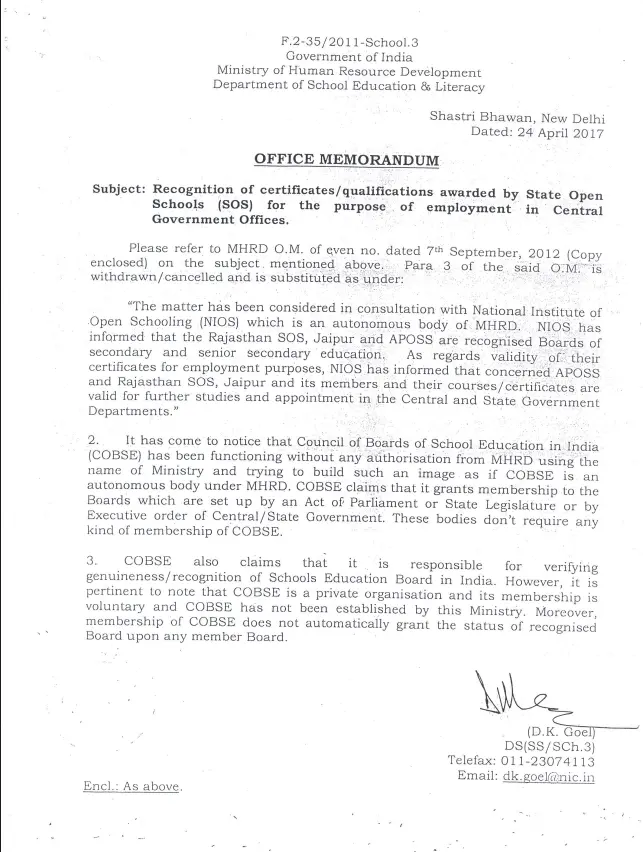
The Ministry of Human Resource Development (now Ministry of Education, Government of India) has officially clarified through policy orders and RTI responses that the Union Government does not maintain or endorse COBSE as a mandatory board-licensing agency. Membership in COBSE is entirely voluntary and is neither a prerequisite nor a conclusive proof of statutory legitimacy.
4. Master Directory of Genuinely Recognized Education Boards in India
The authentic list of school education boards recognized for secondary (Class 10) and senior secondary (Class 12) certifications across India is categorized below:
4.1 Recognized National-Level Formal & Open Boards
|
Board Name |
Category |
Governing Legal Authority |
Official Portal |
|---|---|---|---|
|
CBSE |
National Formal Board |
Autonomous body under Ministry of Education, Government of India |
cbse.gov.in |
|
CISCE (ICSE / ISC) |
National Formal Board |
Registered under Societies Registration Act XXI of 1860 / Recognized National Board |
cisce.org |
|
NIOS |
National Open Board |
Autonomous institution under Ministry of Education, Government of India (Est. 1989) |
nios.ac.in |
|
CBOSE |
Central Board of Open Schooling and Examination |
Registered under Societies Registration Act XXI of 1860 / Recognized National Board |
cbose.com |
4.2 Recognized State Statutory Education Boards (State-Wise)
|
State / UT |
Recognized State Board Name |
Governing State Act / Authority |
|---|---|---|
|
Andhra Pradesh |
Board of Secondary Education, AP (BSEAP) / BIEAP |
Andhra Pradesh Education Act 1982 |
|
Assam |
Board of Secondary Education, Assam (SEBA) / AHSEC |
Assam Secondary Education Act |
|
Bihar |
Bihar School Examination Board (BSEB) |
Bihar School Examination Board Act 1952 |
|
Chhattisgarh |
Chhattisgarh Board of Secondary Education (CGBSE) / CGSOS |
Chhattisgarh Madhyamik Shiksha Act |
|
Goa |
Goa Board of Sec. & Higher Sec. Education (GBSHSE) |
Goa Board of Secondary Education Act 1975 |
|
Gujarat |
Gujarat Secondary & Higher Sec. Edu. Board (GSEB) |
Gujarat Secondary Education Act 1972 |
|
Haryana |
Board of School Education Haryana (BSEH) / HOS |
Haryana School Education Act 1969 |
|
Himachal Pradesh |
Himachal Pradesh Board of School Education (HPBOSE) |
HP Board of School Education Act 1968 |
|
Jammu & Kashmir |
J&K State Board of School Education (JKBOSE) |
J&K Board of School Education Act 1975 |
|
Jharkhand |
Jharkhand Academic Council (JAC) |
Jharkhand Academic Council Act 2002 |
|
Karnataka |
Karnataka School Exam & Assessment Board (KSEAB) |
Karnataka Education Act 1983 |
|
Kerala |
Kerala Board of Public Examinations (KBPE) / DHSE |
Kerala Education Act 1958 |
|
Madhya Pradesh |
Board of Secondary Education, MP (MPBSE) / MPSOS |
MP Madhyamik Shiksha Adhiniyam 1965 |
|
Maharashtra |
Maharashtra State Board of Sec. & Higher Sec. (MSBSHSE) |
Maharashtra Secondary Education Boards Act 1965 |
|
Odisha |
Board of Secondary Education, Odisha (BSEO) / CHSE |
Odisha Secondary Education Act 1953 |
|
Punjab |
Punjab School Education Board (PSEB) |
Punjab School Education Board Act 1969 |
|
Rajasthan |
Board of Secondary Education, Rajasthan (BSER) / RSOS |
Rajasthan Secondary Education Act 1957 |
|
Tamil Nadu |
Tamil Nadu State Board of School Examinations (TNBSE) |
TN State Board of Education Guidelines |
|
Telangana |
Telangana Board of Secondary Education (BSET) / TSBIE |
Telangana Education Act 1982 |
|
Uttar Pradesh |
UP Madhyamik Shiksha Parishad (UPMSP) |
UP Intermediate Education Act 1921 |
|
Uttarakhand |
Uttarakhand Board of School Education (UBSE) |
Uttarakhand School Education Act 2006 |
|
West Bengal |
West Bengal Board of Sec. Edu. (WBBSE) / WBCHSE |
West Bengal Secondary Education Act 1963 |
5. How Government Bodies & Universities Truly Verify Boards
During Document Verification (DV) for Government Jobs (India Post GDS, SSC, Railways, Defence) and University Admissions (NEET, JEE, CUET), recruiting authorities examine authentic legal criteria rather than checking private society lists:
6. Advisory for Students and Job Aspirants
Students and parents are strongly cautioned against unverified online directories claiming that 'only COBSE-listed boards are genuine.' When evaluating an educational board:
7. Frequently Asked Questions
Q1. Is the COBSE member list the official list of recognized boards in India?
No. The COBSE list is merely an internal membership roster of a private registered society. It is NOT the official government directory of recognized educational boards in India.
Q2. Where can I find the authentic list of recognized school boards in India?
The authentic recognized boards comprise statutory boards created by Acts of Parliament (CBSE, NIOS), State Legislative Acts (UPMSP, MSBSHSE, BSEB, etc.), and autonomous boards with Official Government Gazette notifications.
Q3. Can an educational board be legally recognized without being in COBSE?
Yes, 100%. COBSE membership is entirely voluntary. An educational board derives full legal recognition from its parent statutory legislation or Official Gazette Notification, completely independent of COBSE.
Q4. Do government recruitment agencies like SSC, UPSC, and India Post require COBSE membership?
No. Government recruitment rules mandate passing from a recognized Board of School Education established under law. None of the official recruitment guidelines require a board to be affiliated with COBSE.
Q5. What should a student do if told that a board is 'fake' just because it is not in COBSE?
Students should check the board's statutory registration, Official Government Gazette Notification, and online marksheet verification system. Claims that non-COBSE boards are fake are legally false and baseless.
8. Conclusion & Public Information Statement
The pervasive search engine confusion equating COBSE membership with government recognition must be decisively corrected. Education in India is governed by constitutional law, legislative enactments, and official government gazettes. Educational boards established under legitimate statutory frameworks operate with complete legal validity across India, regardless of membership in any private society.