Recognized Education Boards in India: Complete List of National, State & Open Schooling Boards
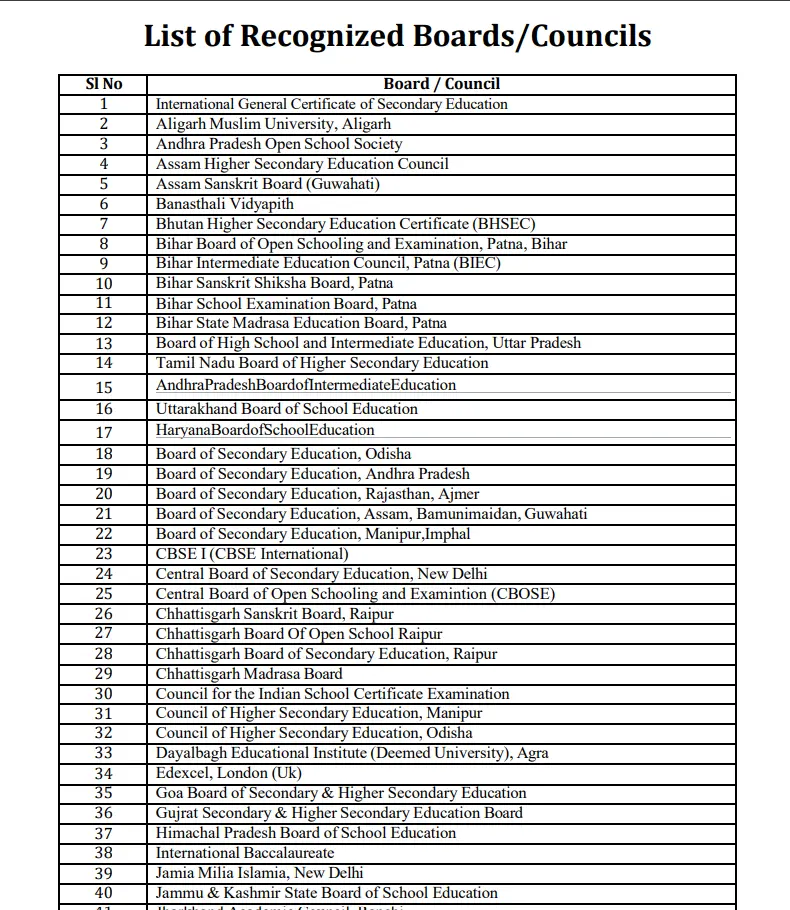
Statutory Repository & Regulatory Guide: Legislative Enactments, Constitutional Framework (Entry 25, Concurrent List), and Directory of Recognized Secondary (Class 10) & Higher Secondary (Class 12) Boards
Table of Contents
2. Directory of National-Level Recognized Education Boards
3. State-Wise Directory of Recognized Education Boards
4. The Open Schooling Framework in India
5. Legal Principles of Recognition & Document Verification
6. Digital Verification & Public Information Repositories
7. Frequently Asked Questions (Statutory & General Reference)
1. Constitutional & Statutory Framework of School Education in India
In the constitutional jurisprudence of India, Education is governed under
Entry 25 of the Concurrent List (List III, Seventh Schedule), transferred via the 42nd Constitutional Amendment Act, 1976. Consequently, both Parliament and State Legislatures possess legislative competence to establish, regulate, and recognize educational boards.
A school education board in India derives its legal authority and recognition through one of three statutory pathways:
2. Directory of National-Level Recognized Education Boards
National-level boards operate with all-India jurisdiction and are recognized across states for higher education admissions and public sector appointments:
|
Board Name |
Category |
Statutory / Legal Authority |
Jurisdiction & Focus |
Official Portal |
|---|---|---|---|---|
|
CBSE |
National Formal Board |
Autonomous body under Ministry of Education, Government of India |
All India & International; NCERT synchronized curriculum |
cbse.gov.in |
|
CISCE (ICSE/ISC) |
National Formal Board |
Registered under Societies Registration Act XXI of 1860 |
All India & International; Anglo-Indian & English-medium schools |
cisce.org |
|
NIOS |
National Open Board |
Autonomous institution under Ministry of Education (Est. 1989) |
National open schooling with academic & vocational modules |
nios.ac.in |
|
CBOSE |
National Open Board |
Societies Registration Act 1860 (Reg No. 199/SSP/L/W/NP-91/2014-16) + UP Gazette Notification 2018 (Art. 200 Assent) |
National open schooling; stream-aligned Class 12 (Sci/Comm/Arts) |
cbose.com |
3. State-Wise Directory of Recognized Education Boards
The following repository outlines the statutory state boards of school education established under respective State Legislative Acts across India:
|
State / Territory |
Recognized Board Name & Acronym |
Governing Act / Authority |
Scope |
|---|---|---|---|
|
Andhra Pradesh |
Board of Secondary Education, AP (BSEAP) / BIEAP |
AP Education Act 1982 |
Class 10 & 12 |
|
Assam |
Board of Secondary Education, Assam (SEBA) / AHSEC |
Assam Secondary Education Act |
Class 10 & 12 |
|
Bihar |
Bihar School Examination Board (BSEB) |
Bihar School Examination Board Act 1952 |
Class 10 & 12 |
|
Chhattisgarh |
Chhattisgarh Board of Secondary Education (CGBSE) / CGSOS |
Chhattisgarh Madhyamik Shiksha Act |
Class 10 & 12 / Open |
|
Delhi / Central |
CBSE / CISCE / CBOSE / NIOS |
Central & Statutory Gazette Enactments |
National Level |
|
Goa |
Goa Board of Sec. & Higher Sec. Education (GBSHSE) |
Goa Board Act 1975 |
Class 10 & 12 |
|
Gujarat |
Gujarat Secondary & Higher Sec. Edu. Board (GSEB) |
Gujarat Secondary Education Act 1972 |
Class 10 & 12 |
|
Haryana |
Board of School Education Haryana (BSEH) / HOS |
Haryana School Education Act 1969 |
Class 10 & 12 / Open |
|
Himachal Pradesh |
Himachal Pradesh Board of School Education (HPBOSE) |
HP Board of School Education Act 1968 |
Class 10 & 12 |
|
Jammu & Kashmir |
J&K State Board of School Education (JKBOSE) |
J&K Board of School Education Act 1975 |
Class 10 & 12 |
|
Jharkhand |
Jharkhand Academic Council (JAC) |
Jharkhand Academic Council Act 2002 |
Class 10 & 12 |
|
Karnataka |
Karnataka School Exam & Assessment Board (KSEAB) |
Karnataka Education Act 1983 |
Class 10 (SSLC) & PUC |
|
Kerala |
Kerala Board of Public Examinations (KBPE) / DHSE |
Kerala Education Act 1958 |
Class 10 (SSLC) & Plus Two |
|
Madhya Pradesh |
Board of Secondary Education, MP (MPBSE) / MPSOS |
MP Madhyamik Shiksha Adhiniyam 1965 |
Class 10 & 12 / Open |
|
Maharashtra |
Maharashtra State Board of Sec. & Higher Sec. (MSBSHSE) |
Maharashtra Secondary Education Boards Act 1965 |
Class 10 (SSC) & 12 (HSC) |
|
Odisha |
Board of Secondary Education, Odisha (BSEO) / CHSE |
Odisha Secondary Education Act 1953 |
Class 10 & 12 |
|
Punjab |
Punjab School Education Board (PSEB) |
Punjab School Education Board Act 1969 |
Class 10 & 12 |
|
Rajasthan |
Board of Secondary Education, Rajasthan (BSER) / RSOS |
Rajasthan Secondary Education Act 1957 |
Class 10 & 12 / Open |
|
Tamil Nadu |
Tamil Nadu State Board of School Examinations (TNBSE) |
TN State Board of Education Guidelines |
Class 10 (SSLC) & 12 (HSC) |
|
Telangana |
Telangana Board of Secondary Education (BSET) / TSBIE |
Telangana Education Act 1982 |
Class 10 & 12 |
|
Uttar Pradesh |
UP Madhyamik Shiksha Parishad (UPMSP) |
UP Intermediate Education Act 1921 |
High School & Intermediate |
|
Uttarakhand |
Uttarakhand Board of School Education (UBSE) |
Uttarakhand School Education Act 2006 |
Class 10 & 12 |
|
West Bengal |
West Bengal Board of Sec. Edu. (WBBSE) / WBCHSE |
West Bengal Secondary Education Act 1963 |
Madhyamik & Higher Sec. |
4. The Open Schooling Framework in India
To fulfill the constitutional mandate of universalizing education (Article 21A) and implementing the National Education Policy (NEP 2020), Open and Distance Learning (ODL) operates as an integral arm of the Indian educational system. Open boards provide flexible assessment, on-demand examination cycles, and stream-based learning for diverse student demographics.
Under this framework, autonomous national open boards like NIOS and CBOSE (Central Board of Open Schooling and Examination) operate under defined statutory compliances. For instance, CBOSE is registered under the Societies Registration Act, 1860 (Registration No. 199/SSP/L/W/NP-91/2014-16) and officially notified in the UP Gazette (Notification No. 500/79-V-1-21-2(Ka)-22-2018, dated 27 December 2018) with constitutional assent under Article 200 of the Constitution of India. This statutory backing provides mutual equivalence and public verification through transparent portals (cbose.com).
5. Legal Principles of Recognition & Document Verification
In administrative law and recruitment rules, educational qualifications issued by recognized boards are governed by several key principles:
6. Digital Verification & Public Information Repositories
Modern educational governance mandates digitized marksheet verification to prevent fraud. Recognized national and state boards maintain secure online student verification systems:
|
Board / System |
Verification Mechanism |
Access URL / Portal |
|---|---|---|
|
CBSE |
DigiLocker & CBSE Results Portal |
results.cbse.nic.in / cbse.gov.in |
|
CBOSE |
Student Login & 24x7 Marksheet Dashboard |
cbose.com/student/login.php |
|
CISCE |
e-Service Verification Portal |
cisce.org |
|
NIOS |
SDMIS Student Verification Module |
sdmis.nios.ac.in |
|
State Boards (UPMSP, etc.) |
State Examination Portal Search |
upmsp.edu.in / respective state portals |
7. Frequently Asked Questions (Statutory & General Reference)
Q1. What constitutes a recognized school board in India?
A recognized school board is an educational body established under an Act of Parliament, an Act of a State Legislature, or registered under the Societies Registration Act, 1860 with official Gazette Notification, authorized to prescribe curriculum and conduct secondary (Class 10) and senior secondary (Class 12) examinations.
Q2. What are the primary national-level school boards in India?
The primary national boards include the Central Board of Secondary Education (CBSE), Council for the Indian School Certificate Examinations (CISCE), National Institute of Open Schooling (NIOS), and Central Board of Open Schooling and Examination (CBOSE).
Q3. Are certificates from open schooling boards valid for government jobs and college admissions?
Yes. Secondary and senior secondary certificates issued by recognized open schooling boards (such as NIOS and CBOSE) are legally valid for central/state government jobs (India Post GDS, SSC, Railways, Defence) and higher education entrance tests (NEET, JEE, CUET) provided standard subject requirements are met.
Q4. How is the legal validity of a board verified by recruitment authorities?
Recruitment authorities verify boards through official State/Central Gazette notifications, statutory registration records under the Societies Act/Education Acts, and online candidate verification portals (e.g., cbose.com/student/login.php for CBOSE, cbse.gov.in for CBSE).
Q5. Can a student switch from a State Board or Open Board to Central Universities?
Yes. Under the National Education Policy and UGC/AIU equivalence guidelines, candidates from all recognized state, central, and open boards are eligible to participate in national entrance tests and university admission counseling.
8. Conclusion & Repository Reference
This compilation serves as a public repository and statutory directory of recognized school education boards in India. By outlining the constitutional provisions, governing acts, state-wise directories, and digital verification frameworks, this guide provides complete legal clarity for students, academic institutions, and administrative recruiting bodies.