Recognized Educational Boards in India: National, State & Open Boards Directory
Table of Contents
- Introduction: School Education & Legal Framework of Boards in India
- Apex Regulating Authorities vs Private Bodies: The Reality of COBSE
Statutory Authorities that Actually Hold Legal Power in India:
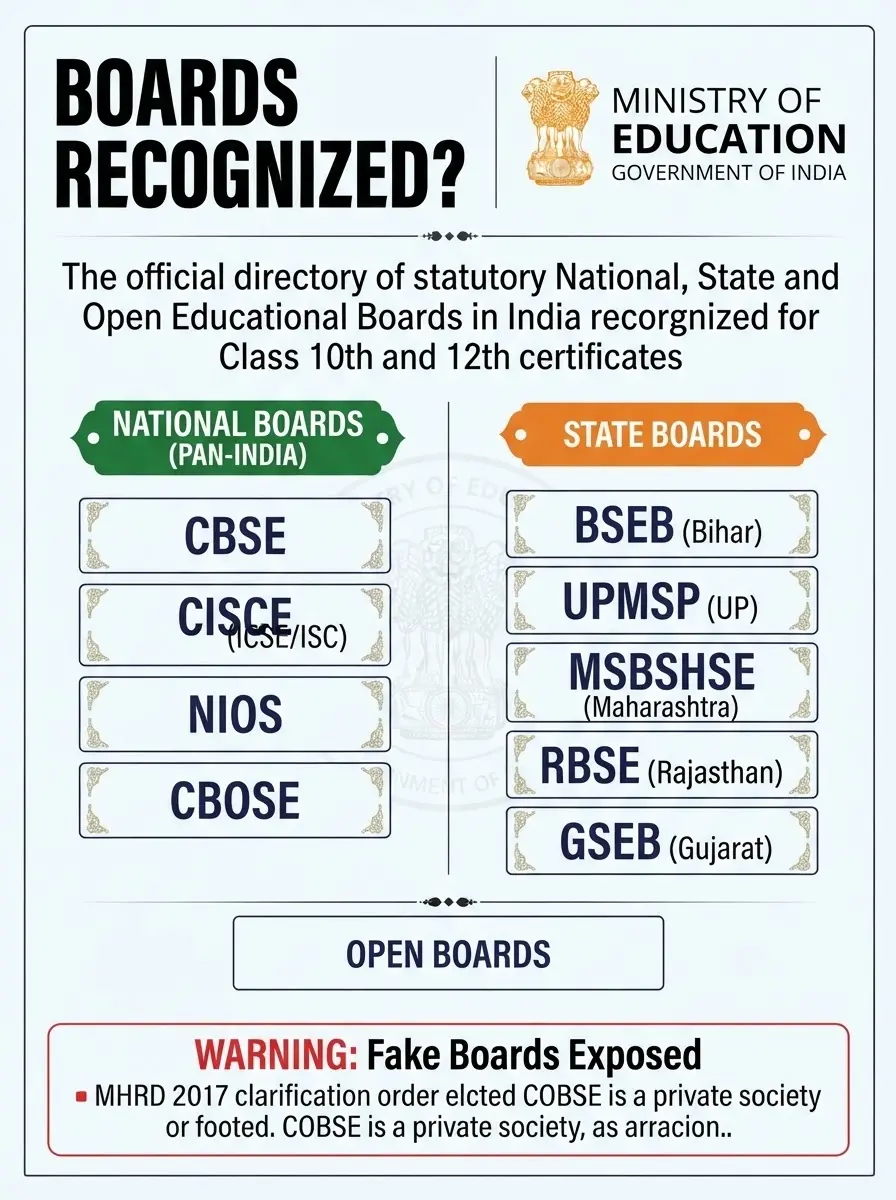
- National Educational Boards in India (Pan-India Presence)
Detailed Overview of Major National & Open Boards
- State-wise Recognized Educational Boards in India
- Board Comparison: National vs State vs Open Boards
- Verification Protocol & Fake Board Warning (2017 Govt Clarification)
- Legal Framework & Government of India Clarification Orders
- Frequently Asked Questions (FAQs) - High SEO Value
- Introduction: School Education & Legal Framework of Boards in India
India's school education system is one of the largest in the world, with over 1.5 million schools and more than 250 million enrolled students. Under the Constitution of India, Education is governed under the Concurrent List (Entry 25, List III of the Seventh Schedule), conferring legislative competence on both the Parliament of India (Central Government) and State Legislatures (State Governments) to establish and regulate educational authorities.
For any Class 10 (Secondary) or Class 12 (Senior Secondary) certificate to be legally valid across universities (UGC, AIU, NEET, JEE, CUET) and public employment (UPSC, SSC, Defence, State PSCs), the examining board must possess statutory recognition established by Law.
- Apex Regulating Authorities vs Private Bodies: The Reality of COBSE
A widespread misconception in the education sector is that membership or listing in COBSE confers legal recognition. It is critical to understand the legal distinction:
⚠️ Legal Fact: COBSE is a Private Registered Society, NOT a Statutory Government Body:
The Council of Boards of School Education in India (COBSE) is merely a private voluntary association registered under the Societies Registration Act, 1860. COBSE DOES NOT have statutory authority to recognize, validate, or grant equivalence to any educational board. The Ministry of Human Resource Development (MHRD / now Ministry of Education, Govt. of India) issued clear orders clarifying that COBSE is a private body and its membership alone holds no legal weight without statutory legislative backing.
Statutory Authorities that Actually Hold Legal Power in India:
Ministry of Education (MoE), Government of India: Formulates national education policies (NEP 2020), oversees national boards, and issues official derecognition notices.
State Legislatures / State Education Departments: Enact statutory Acts establishing state secondary and higher secondary education boards.
Association of Indian Universities (AIU): Evaluates equivalence of senior secondary examinations and international qualifications for university admissions.
National Council of Educational Research and Training (NCERT): Develops the National Curriculum Framework (NCF) and school textbooks.
University Grants Commission (UGC) & AICTE: Mandate that undergraduate admissions require certificates only from recognized central/state statutory boards.
- National Educational Boards in India (Pan-India Presence)
National boards conduct secondary and senior secondary examinations across the country and are accepted for civil services, national entrance tests (NEET/JEE), and higher studies worldwide.
|
Board Name |
Acronym / Type |
Governing Body / Status |
Mode of Education |
Curriculum & Focus |
|
Central Board of Secondary Education |
CBSE |
Statutory (Ministry of Education, GoI) |
Regular Schooling |
NCERT Syllabus, NEET/JEE/CUET Alignment |
|
Council for the Indian School Certificate Examinations |
CISCE (ICSE/ISC) |
Recognized All-India Body |
Regular Schooling |
Comprehensive English, Science & Humanities |
|
National Institute of Open Schooling |
NIOS |
Autonomous Body (Ministry of Education, GoI) |
Open & Distance Learning (ODL) |
Universal Open Schooling, Skill Courses |
|
Central Board of Open Schooling and Examination |
CBOSE |
Autonomous Open Schooling Board |
Open & Distance Learning (ODL) |
Flexible Secondary & Senior Secondary Courses |
|
Central Tibetan Schools Administration |
CTSA |
Autonomous Body under MoE |
Regular / Special |
Tibetan Refugee Community Education |
|
Rashtriya Sanskrit Sansthan / MSRVVP |
RSKS / Vedic Board |
Autonomous Body under MoE |
Traditional & Regular |
Sanskrit & Vedic Studies Integration |
Detailed Overview of Major National & Open Boards
- Central Board of Secondary Education (CBSE)
CBSE is India's flagship national board with over 28,000+ affiliated schools across India and 26 foreign nations. It conducts the All India Secondary School Examination (AISSE - Class 10) and All India Senior School Certificate Examination (AISSCE - Class 12).
- Council for the Indian School Certificate Examinations (CISCE)
CISCE conducts ICSE (Class 10) and ISC (Class 12) examinations. It is renowned for its intensive language requirements, practical laboratory assessments, and deep foundational concepts.
- National Institute of Open Schooling (NIOS)
Established by the Ministry of Education in 1989, NIOS is the world's largest open schooling network. Its certificates possess complete legal parity with CBSE and State Boards for all government jobs (UPSC, SSC, Defence) and university entrance examinations.
- Central Board of Open Schooling Education (CBOSE) & Open Schooling Ecosystem
Open schooling boards like CBOSE cater to non-formal learners, working individuals, dropouts, and remote students who require flexible pacing, self-learning modules, and credit transfer options under the national open learning framework.
- State-wise Recognized Educational Boards in India
Every State Government in India operates one or more statutory boards enacted through State Legislative Acts. Certificates issued by these boards are legally recognized throughout India:
|
State / UT |
Recognized Secondary & Higher Secondary Board(s) |
Official Portal |
|
Andhra Pradesh |
Board of Secondary Education (BSEAP) / Board of Intermediate Education (BIEAP) |
bse.ap.gov.in / bie.ap.gov.in |
|
Assam |
Board of Secondary Education, Assam (SEBA) / Assam Higher Secondary Education Council (AHSEC) |
sebaonline.org / ahsec.assam.gov.in |
|
Bihar |
Bihar School Examination Board (BSEB) |
biharboardonline.bihar.gov.in |
|
Chhattisgarh |
Chhattisgarh Board of Secondary Education (CGBSE) |
cgbse.nic.in |
|
Delhi |
Delhi Board of School Education (DBSE) |
dbse.delhi.gov.in |
|
Goa |
Goa Board of Secondary and Higher Secondary Education (GBSHSE) |
gbshse.in |
|
Gujarat |
Gujarat Secondary and Higher Secondary Education Board (GSEB) |
gseb.org |
|
Haryana |
Board of School Education Haryana (BSEH / HBSE) |
bseh.org.in |
|
Himachal Pradesh |
Himachal Pradesh Board of School Education (HPBOSE) |
hpbose.org |
|
Jammu & Kashmir |
Jammu and Kashmir State Board of School Education (JKBOSE) |
jkbose.nic.in |
|
Jharkhand |
Jharkhand Academic Council (JAC) |
jac.jharkhand.gov.in |
|
Karnataka |
Karnataka School Examination and Assessment Board (KSEAB) |
kseab.karnataka.gov.in |
|
Kerala |
Kerala Pareeksha Bhavan / Directorate of General Education (DHSE Kerala) |
pareekshabhavan.kerala.gov.in |
|
Madhya Pradesh |
Madhya Pradesh Board of Secondary Education (MPBSE) |
mpbse.nic.in |
|
Maharashtra |
Maharashtra State Board of Secondary and Higher Secondary Education (MSBSHSE) |
mahahsscboard.in |
|
Manipur |
Board of Secondary Education Manipur (BOSEM) / Council of Higher Secondary Education Manipur (COHSEM) |
bosem.in / cohsem.nic.in |
|
Meghalaya |
Meghalaya Board of School Education (MBOSE) |
mbose.in |
|
Mizoram |
Mizoram Board of School Education (MBSE) |
mbse.edu.in |
|
Nagaland |
Nagaland Board of School Education (NBSE) |
nbsenl.edu.in |
|
Odisha |
Board of Secondary Education, Odisha (BSE Odisha) / Council of Higher Secondary Education (CHSE) |
bseodisha.ac.in / chseodisha.nic.in |
|
Punjab |
Punjab School Education Board (PSEB) |
pseb.ac.in |
|
Rajasthan |
Board of Secondary Education, Rajasthan (BSER / RBSE) |
rajeduboard.rajasthan.gov.in |
|
Tamil Nadu |
Tamil Nadu State Board of School Examinations (TNDGE) |
dge.tn.gov.in |
|
Telangana |
Telangana Board of Secondary Education (BSETELANGANA) / Telangana State Board of Intermediate Education (TSBIE) |
bse.telangana.gov.in / tsbie.cgg.gov.in |
|
Tripura |
Tripura Board of Secondary Education (TBSE) |
tbse.tripura.gov.in |
|
Uttar Pradesh |
UP Board of High School and Intermediate Education (UPMSP) |
upmsp.edu.in |
|
Uttarakhand |
Uttarakhand Board of School Education (UBSE) |
ubse.uk.gov.in |
|
West Bengal |
West Bengal Board of Secondary Education (WBBSE) / West Bengal Council of Higher Secondary Education (WBCHSE) |
wbbse.wb.gov.in / wbchse.wb.gov.in |
- Board Comparison: National vs State vs Open Boards
A comparison of curriculum orientation, competitive suitability, and flexibility across board types:
|
Evaluation Criteria |
CBSE |
CISCE (ICSE/ISC) |
State Boards |
Open Boards (NIOS/CBOSE) |
|
Primary Focus |
NCERT, Competitive Exams |
Language, Arts & Science Depth |
Regional Syllabus, State History |
Flexibility, Skill & Self-Paced |
|
Exam Structure |
Annual National Board Exams |
Comprehensive Subject Tests |
State-wide Centralized Exams |
On-Demand & Term-End Exams |
|
National Validity |
100% Pan-India |
100% Pan-India & Global |
100% Across All States |
Valid for Entrances & Jobs |
|
Transferability |
Very Easy (Inter-State) |
Easy Across Affiliated Schools |
Requires Migration Formalities |
Flexible Credit Transfer |
↕
Estimated Student Enrollment Share across Board Categories (%)
|
|
State Boards (All States) |
CBSE |
CISCE (ICSE/ISC) |
Open Schooling (NIOS/CBOSE/State ODL) |
Other Recognized Bodies |
|
Student Distribution |
67 |
23 |
4 |
4 |
2 |
- Verification Protocol & Fake Board Warning (2017 Govt Clarification)
🚨 Crucial Consumer & Student Protection Warning:
Numerous fraudulent organizations operate under misleading names (e.g., 'Board of Higher Secondary Education, Delhi', 'National Board of School Education', 'Central Board of Higher Education'). Many fake boards falsely claim 'COBSE Membership' or 'Registered under Govt of India Societies Act' to mislead parents. As per official Ministry guidelines, society registration under Act XXI of 1860 does NOT confer any legal right to conduct public examinations or award 10th/12th certificates.
4-Step Legal Verification Checklist:
Check Statutory Legislative Backing: Verify whether the board was enacted through a specific Act of Parliament or State Legislative Assembly.
Do Not Rely Solely on COBSE Membership: Recognize that COBSE is a private voluntary society and not a statutory recognition granting authority.
Verify Equivalence from AIU (Association of Indian Universities): Confirm if senior secondary equivalency is officially notified by AIU.
Verify with Central Exam Portals: Ensure the board code appears in official admission and exam portals (NTA NEET/JEE, UPSC, SSC, CUET).
- Legal Framework & Government of India Clarification Orders
The legal validity of educational boards and private councils has been settled through key Government directives and Supreme Court rulings:
MHRD / Ministry of Education 2017 Clarification Order: The Government of India formally clarified that COBSE is a private voluntary association registered under the Societies Registration Act and NOT a statutory body or agency of the Central Government. The Govt reiterated that COBSE has no legal mandate to grant recognition or equivalence to any school board.
State of Tamil Nadu v. K. Shyam Sunder (2011) 8 SCC 737: The Hon'ble Supreme Court held that the State has a constitutional obligation under Article 21A to ensure quality and uniform standards of education through authorized statutory frameworks.
Criminal Prosecution under Indian Penal Code / Bharatiya Nyaya Sanhita: Operating an unapproved board claiming fake government recognition constitutes cheating, forgery, and unfair trade practices under Section 420/468 IPC and the Consumer Protection Act, 2019.
- Frequently Asked Questions (FAQs) - High SEO Value
Q1. What is COBSE and does COBSE membership mean a board is legally recognized?
No. COBSE (Council of Boards of School Education in India) is a private voluntary association registered under the Societies Registration Act, 1860. It is NOT a statutory government body and has no legal authority to grant recognition or equivalence. Merely being a member of COBSE does not make a board legally valid under Indian law.
Q2. What is the 2017 Government Order regarding COBSE and board recognition?
In 2017, the Ministry of Human Resource Development (MHRD / now Ministry of Education, Govt. of India) issued an official clarification stating that COBSE is a private registered society and not an agency of the Government of India. The order clarified that COBSE cannot grant recognition to any educational board, and only boards established by an Act of Parliament or State Legislature hold statutory validity.
Q3. What is CBOSE and what role does it play in open schooling?
CBOSE (Central Board of Open Schooling Education) functions in the open and distance learning (ODL) domain, providing flexible secondary and senior secondary education pathways for self-paced students, dropouts, and vocational learners alongside other open learning initiatives.
Q4. Can a private trust or society create a legally valid school education board?
No. A society registered under the Societies Registration Act or a trust registered under the Indian Trusts Act cannot conduct public board exams or issue Class 10/12 certificates without statutory enactment by the Central Parliament or a State Legislature.
Q5. Is NIOS valid for NEET, JEE, UPSC, and Central Government jobs?
Yes, 100%. NIOS (National Institute of Open Schooling) was established as an autonomous body by the Ministry of Education, Government of India in 1989. Its certificates have absolute legal equality with CBSE and State Boards for all entrance exams, higher education, and government recruitment.
Q6. How can a student check if an educational board is fake or genuine?
Students must check if the board was established under an Act of Parliament (like CBSE, NIOS) or an Act of State Legislature (like UPMSP, BSEB, MSBSHSE). Check official notifications on education.gov.in and verify if the board is recognized in the AIU directory and national competitive examination lists (NTA, UPSC).