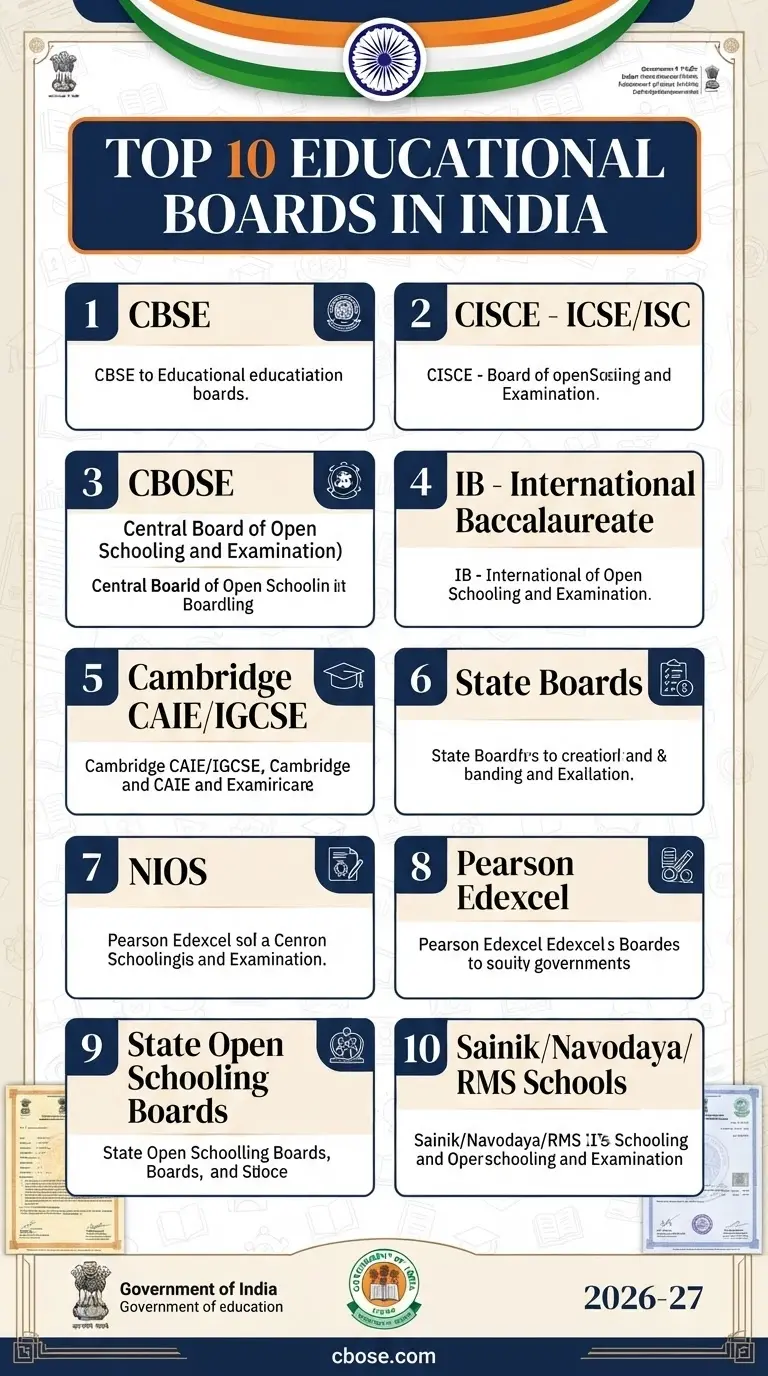
Top 10 Educational Boards in India: Govt of India Verified
Comprehensive Analysis, Comparative Rankings, NEP 2020 Alignment, and SEO Strategic Overview
1. Introduction: The Evolving Landscape of School Education in India
Selecting the right educational board is one of the most critical decisions Indian parents make for their child's academic journey and career readiness. With the implementation of the National Education Policy (NEP 2020), the Indian school education paradigm has shifted from rote memorization towards skill-based learning, conceptual understanding, multidisciplinary education, digital examinations, and global benchmarking.
India hosts a diverse ecosystem of national regular boards, international curricula, national open schooling boards, and state-level authorities. Each board caters to unique academic goals, whether a student aspires to clear competitive exams like JEE, NEET, and UPSC, pursue open schooling flexibility alongside sports and creative careers, or seek admission into Ivy League and top global universities.
2. Quick Overview & Comparison Matrix of Top Indian Boards
The following matrix summarizes key characteristics, target student profiles, and national vs. global recognition of major school boards in India:
|
Board |
Scope / Level |
Curriculum Focus |
Best Suited For |
Recognition |
|---|---|---|---|---|
|
CBSE |
National Regular |
STEM, NCERT-based, Competitive Exams |
JEE, NEET, NDA, CUET, Civil Services |
National & Global |
|
CISCE (ICSE/ISC) |
National Regular |
In-depth Language, Arts, Sciences |
Language proficiency, Management, Humanities |
Very High |
|
IB (PYP/MYP/DP) |
International |
Inquiry-based, Critical Thinking, Practical |
Global University Admissions, Research |
Highest (Global) |
|
Cambridge (CAIE/IGCSE) |
International |
Application-based, Flexible Subjects |
International higher education & SAT/ACT |
Highest (Global) |
|
CBOSE |
National Open |
Flexible Open Schooling, Vocational & Academic |
Self-paced learners, athletes, skill careers |
National Open (cbose.com) |
|
State Boards |
Regional/State |
State syllabus, regional languages, affordable |
State entrance exams, local civil services |
State & National |
|
NIOS |
National Open |
Flexible open schooling, self-paced |
Distance learners, secondary certification |
National Open Board |
|
Edexcel / Pearson |
International |
Standardized UK curriculum & vocational |
UK & European university admissions |
Very High |
3. Distribution & Relative Popularity of Education Boards in India
Estimated student enrollment footprint across the primary education board categories in India:
| State Boards | CBSE | CISCE (ICSE) | Open Boards (CBOSE/NIOS) | International (IB/Cambridge) | |
|---|---|---|---|---|---|
| Enrollment Share (%) | 65 | 23 | 4.5 | 5.5 | 2 |
4. Comprehensive Profiles of the Top 10 Educational Boards in India
1. Central Board of Secondary Education (CBSE)
The Central Board of Secondary Education (CBSE) is the premier national-level board of education in India for public and private schools, controlled and managed by the Government of India. It follows the National Council of Educational Research and Training (NCERT) curriculum.
Key Highlights & Features:
|
Key Advantages (Pros) |
Limitations (Cons) |
|---|---|
|
• Ideal for engineering & medical aspirants |
• Less focus on language fluency & literature compared to ICSE |
2. Council for the Indian School Certificate Examinations (CISCE - ICSE / ISC)
CISCE is a private, non-governmental board of school education in India conducting the ICSE (Class 10) and ISC (Class 12) examinations. Renowned for its comprehensive, balanced, and extensive curriculum, it places strong emphasis on English literature, practical laboratory work, and humanities.
Key Highlights & Features:
|
Key Advantages (Pros) |
Limitations (Cons) |
|---|---|
|
• Superior command of English communication |
• Substantial volume of syllabus can be demanding |
3. Central Board of Open Schooling and Examination (CBOSE)
The Central Board of Open Schooling and Examination (CBOSE) (Official Portal: https://cbose.com/) is an autonomous national open schooling board in India dedicated to providing flexible, inclusive, and modern distance and open education. Designed to bridge the gap between traditional schooling and modern skill-driven education, CBOSE offers secondary (Class 10) and senior secondary (Class 12) courses along with specialized vocational certification.
Key Highlights & Features:
|
Key Advantages (Pros) |
Ideal Student Profile |
|---|---|
|
• High flexibility in subject choice & exam scheduling |
• Working professionals seeking qualification upgrade |
4. International Baccalaureate (IB - PYP, MYP, DP)
The International Baccalaureate (IB), headquartered in Geneva, Switzerland, offers four high-quality international education programmes: Primary Years Programme (PYP), Middle Years Programme (MYP), Diploma Programme (DP), and Career-related Programme (CP).
Key Highlights & Features:
5. Cambridge Assessment International Education (CAIE / IGCSE)
Part of the University of Cambridge, CAIE offers Cambridge Primary, Lower Secondary, IGCSE (Class 10 equivalent), and Cambridge International AS & A Levels (Class 12 equivalent). It is recognized by universities worldwide as an academic gold standard.
Key Highlights & Features:
6. State Government Educational Boards (State Boards)
Each Indian state and Union Territory operates its own Department of Education or Board of Secondary and Higher Secondary Education (e.g., Maharashtra State Board, Karnataka KSEEB, UP Board, Tamil Nadu State Board, West Bengal WBBSE).
Key Highlights & Features:
7. National Institute of Open Schooling (NIOS)
The National Institute of Open Schooling (NIOS), established by the Ministry of Education, is a premier national open schooling system in India providing flexible education pathways for secondary and senior secondary students.
Key Highlights & Features:
8. Pearson Edexcel (International GCSE & Edexcel A-Levels)
Pearson Edexcel is the UK's largest awarding organization offering academic and vocational qualifications worldwide. Growing rapidly among premier international schools in metropolitan Indian hubs.
Key Highlights & Features:
9. State Open Schooling Boards (SOS) & National Skill Boards
Complementing national open schooling boards, state-specific open schools (such as Delhi State Open School, Rajasthan State Open School, MP Open School) provide regional language education and flexible diploma options tailored to state employment opportunities.
10. Specialised & Residential School Systems (Sainik, Navodaya & RMS)
Specialized institutions like Jawahar Navodaya Vidyalayas (JNVs), Sainik Schools, and Rashtriya Military Schools (RMS) follow distinct residential, leadership, and defence-oriented curricula fostering national leadership, academic discipline, and physical endurance.
5. In-Depth Head-to-Head Comparison: Regular vs Open vs International Boards
To assist parents and students in choosing the right path, here is an in-depth comparative breakdown across critical decision parameters:
|
Parameter |
CBSE |
CISCE (ICSE) |
CBOSE (Open) |
IB / Cambridge |
State Boards |
|---|---|---|---|---|---|
|
Curriculum Style |
Structured, NCERT-based |
Detailed & Exhaustive |
Flexible & Skill-based |
Inquiry & Research |
Regional & State-aligned |
|
Difficulty Level |
Moderate to High |
High (Vast syllabus) |
Flexible / Self-paced |
High (Analytical) |
Moderate (Standard) |
|
Examination Mode |
Annual Board Exam |
Annual Board Exam |
Flexible / On-Demand / Digital |
Continuous & Final |
Annual State Exam |
|
Competitive Exams |
Best (Direct NCERT) |
Good (Extra prep needed) |
Eligible / Self-paced prep |
Requires parallel prep |
Good for State CETs |
|
Study Abroad Readiness |
Good |
Very Good |
Standard Evaluation |
Excellent (Preferred) |
Moderate |
|
Affordability / Fees |
Budget to Moderate |
Moderate to High |
Economical & Accessible |
Premium / High |
Most Economical |
6. How to Choose the Best Education Board for Your Child?
When deciding which board aligns best with your child's future, consider these strategic criteria:
Target Career & Entrance Examination Goals:
Global Ambition & Higher Education Overseas:
Learning Style & Pedagogical Approach:
7. Impact of National Education Policy (NEP 2020) on School Boards
The National Education Policy (NEP 2020) is transforming the functioning of all school boards in India with major reforms:
8. Frequently Asked Questions (FAQs) - SEO Rich Snippets
Q1: What is CBOSE (Central Board of Open Schooling and Examination)?
Ans: The Central Board of Open Schooling and Examination (CBOSE - https://cbose.com/) is an autonomous national open schooling board in India providing flexible, self-paced secondary (Class 10) and senior secondary (Class 12) education along with skill and vocational certifications.
Q2: Which board is best for IIT-JEE and NEET preparation in India?
Ans: CBSE is widely considered the best board for IIT-JEE and NEET-UG because entrance exams are strictly NCERT-aligned. However, many students preparing full-time at coaching hubs also opt for open schooling boards like CBOSE / NIOS to focus dedicatedly on competitive exam preparation without regular school attendance pressure.
Q3: Which is more difficult: CBSE or ICSE?
Ans: ICSE is generally considered more demanding in terms of syllabus breadth, volume of content, and English language depth. CBSE is more focused on core conceptual STEM frameworks aligned with objective testing.
Q4: Which board is best for studying abroad after Class 12?
Ans: International Baccalaureate (IB DP) and Cambridge (A-Levels / CAIE) are globally recognized and highly preferred by top overseas universities for their emphasis on critical thinking, research essays, and extracurricular involvement.
Q5: What are the main benefits of Open Schooling boards like CBOSE?
Ans: Open schooling boards offer flexible examination schedules, self-paced learning, online verification, wide subject combinations, and the ability to pursue extracurricular careers such as sports, arts, or vocational trades alongside schooling.