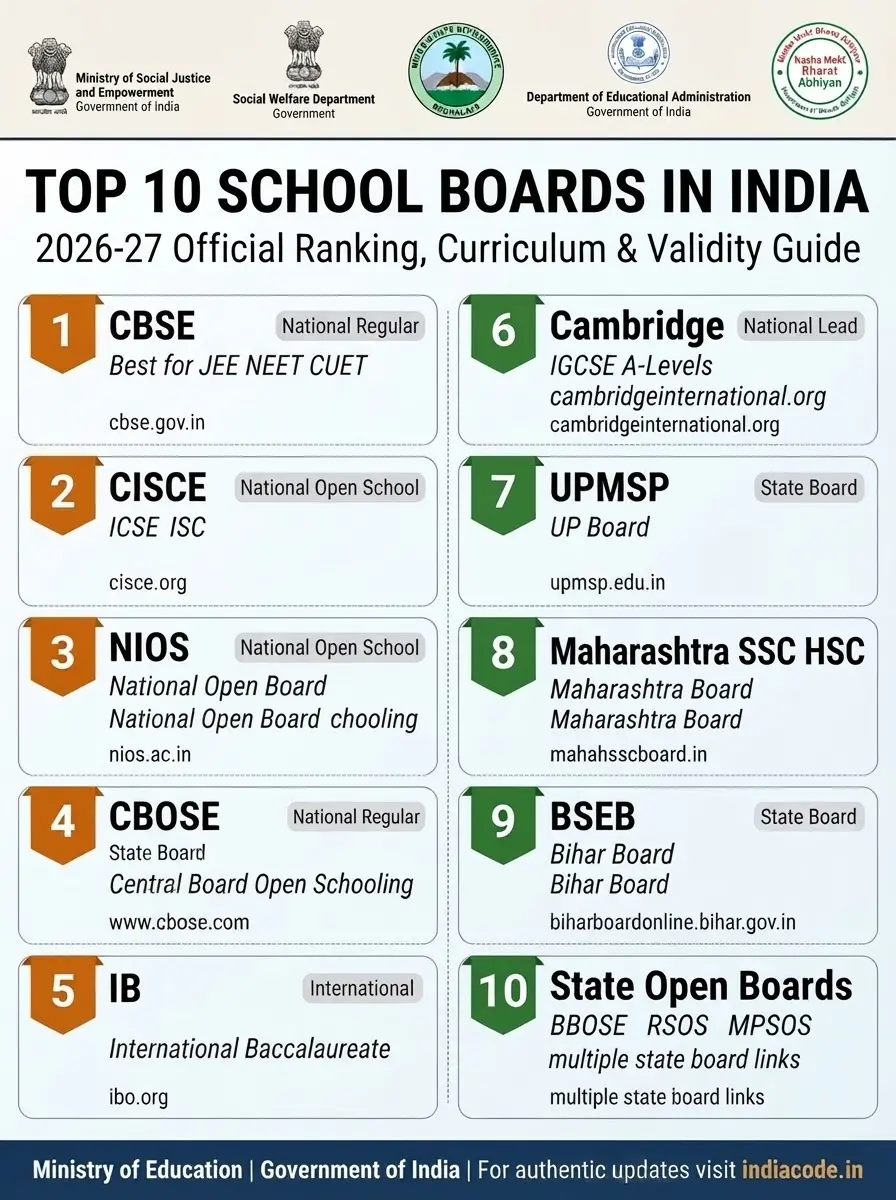
Top 10 School Boards in India (2026-27): Comprehensive Ranking, Curriculum Comparison, Validity & Selection Guide for 10th & 12th
An In-Depth Comparative Analysis of CBSE, ICSE/ISC, NIOS, CBOSE, State Boards, IB, and Cambridge (IGCSE) for Parents, Students & Competitive Exam Aspirants
1. Introduction: Education Landscape & School Boards in India
Choosing the right educational board is one of the most critical decisions in a student's academic journey. The school board directly shapes the curriculum, learning pedagogy, competitive exam readiness (JEE, NEET, CUET, NDA, UPSC), global university recognition, and overall personality development.
In India, school education is delivered across three broad operational models: Central/National Regular Boards (such as CBSE and CISCE), Flexible Open & Distance Learning Boards (such as NIOS and CBOSE), and Regional State Boards (such as UPMSP, Maharashtra Board, and BSEB), alongside International Boards (such as IB and Cambridge IGCSE). For the academic cycle 2026-27, each board brings distinct pedagogical strengths, flexibility levels, and evaluation frameworks.
2. Quick Overview: Top 10 School Boards in India at a Glance
The table below outlines India's top 10 educational boards evaluated on national reach, curriculum depth, competitive exam orientation, flexibility, and global validity:
|
Rank |
Board Name |
Type / Category |
Key USP / Best Suited For |
Official Website |
|---|---|---|---|---|
|
1 |
Central Board of Secondary Education (CBSE) |
National (Regular) |
Best for JEE, NEET, CUET & National Uniformity |
cbse.gov.in |
|
2 |
Council for the Indian School Certificate Exams (CISCE - ICSE/ISC) |
National (Regular) |
Strong English & Comprehensive Conceptual Depth |
cisce.org |
|
3 |
National Institute of Open Schooling (NIOS) |
National (Open School) |
Government Open Board with Biannual Public Exams |
nios.ac.in |
|
4 |
Central Board of Open Schooling and Examination (CBOSE) |
National (Open School) |
Fast-track Open Learning, Skill Integration & Flexible TOC |
cbose.edu.in |
|
5 |
International Baccalaureate (IB) |
International |
Critical Thinking, Global University Admissions & Inquiry |
ibo.org |
|
6 |
Cambridge Assessment International Education (IGCSE / A-Levels) |
International |
Practical Application & Worldwide Academic Mobility |
cambridgeinternational.org |
|
7 |
UP Board of High School & Intermediate Education (UPMSP) |
State Board (Largest) |
Affordable Education & Regional Administrative Strength |
upmsp.edu.in |
|
8 |
Maharashtra State Board (MSBSHSE) |
State Board |
Balanced Technical & State Competitive Exam Curriculum |
mahahsscboard.in |
|
9 |
Bihar School Examination Board (BSEB) |
State Board |
Fast Examination Cycles & Regional Reach |
biharboardonline.bihar.gov.in |
|
10 |
State Open School Boards (BBOSE, RSOS, MPSOS, APOSS) |
State (Open Schools) |
Regional Language Support & State Dropout Rehabilitation |
Respective State Portals |
3. Detailed Analysis of the Top 10 School Boards in India
Rank 1: Central Board of Secondary Education (CBSE)
CBSE is India's most popular national board governed by the Ministry of Education, Govt. of India. It follows the National Council of Educational Research and Training (NCERT) curriculum. Because major national entrance tests—including NEET-UG, JEE Main, and CUET—are directly framed around NCERT textbooks, CBSE is the undisputed #1 choice for competitive entrance examination aspirants.
Rank 2: Council for the Indian School Certificate Examinations (CISCE)
CISCE conducts the ICSE (Class 10) and ISC (Class 12) examinations. Renowned for its rigorous language standards and exhaustive syllabus, CISCE emphasizes equal weightage to Science, Humanities, and Arts, with strong practical and lab-oriented assessments.
Rank 3: National Institute of Open Schooling (NIOS)
NIOS is an autonomous national open schooling board under the Ministry of Education. It provides inclusive education to dropouts, sports persons, home-schoolers, and working individuals, operating on a 5-year cumulative credit system with On-Demand Examinations (ODE).
Rank 4: Central Board of Open Schooling and Examination (CBOSE)
CBOSE has emerged as a premier modern open schooling platform in India, engineered specifically to cater to 21st-century learners requiring flexible pace, career-aligned vocational subjects, and rapid digital examination verification. CBOSE offers seamless 10th (Secondary) and 12th (Senior Secondary) enrollment for students seeking second chances, career-focused skill certifications, or preparing simultaneously for high-intensity competitive entrance tests.
Rank 5: International Baccalaureate (IB - PYP, MYP, DP)
Headquartered in Geneva, IB is a globally recognized curriculum focusing on inquiry-based learning, research, Theory of Knowledge (TOK), and Community Activity Service (CAS). It is ideal for students planning undergraduate studies abroad.
Rank 6: Cambridge Assessment International Education (CAIE - IGCSE & A-Levels)
Offered by the University of Cambridge, CAIE is an international curriculum that offers over 70 subjects at IGCSE and 55 subjects at AS & A-Levels. It focuses on practical application, problem solving, and in-depth academic inquiry.
Rank 7: UP Board of High School & Intermediate Education (UPMSP)
With over 55 lakh students appearing annually, UPMSP is the largest state examination board in Asia. Having adopted NCERT books for major subjects, it serves as the backbone of mass secondary education in North India.
Rank 8: Maharashtra State Board (MSBSHSE - SSC & HSC)
Conducting SSC (10th) and HSC (12th), Maharashtra Board is known for its rigorous science and commerce curriculum tailored to state-level competitive tests such as MHT-CET.
Rank 9: Bihar School Examination Board (BSEB)
BSEB has transformed its examination and evaluation architecture with 50% objective MCQ formats, OMR evaluation, and rapid February-March result declarations, making it a pioneer in timely state-level certifications.
Rank 10: Prominent State Open Schooling Boards (RSOS, MPSOS, APOSS)
State Open Schools established by respective state education departments provide distance schooling in vernacular and regional languages, rehabilitating dropouts and adult learners through schemes like MP's 'Ruk Jana Nahi'.
4. Comparative Matrix: Choosing the Right Board for Your Goals
The matrix below compares the top board categories across critical decision parameters:
|
Parameter |
CBSE |
CISCE (ICSE) |
CBOSE / NIOS (Open) |
International (IB/CAIE) |
State Boards |
|---|---|---|---|---|---|
|
Curriculum Focus |
NCERT Aligned, Science & Math |
English Literature, Comprehensive |
Flexible, Skill + Core Subjects |
Inquiry-Based, Global Research |
State Syllabus / Regional Context |
|
Best For Exams |
NEET, JEE, CUET, NDA |
SAT, ACT, Management, Humanities |
Competitive Preparation + Failed/TOC |
Study Abroad (US/UK/Europe) |
State PSCs, State CETs, Police/Govt |
|
Flexibility |
Moderate (Stream Bound) |
Rigid (Fixed Subject Clusters) |
Maximum (No Stream Constraints) |
High (Modular Subject Pick) |
Moderate to Rigid |
|
Exam Mode |
Annual Pen-Paper |
Annual Pen-Paper |
Biannual / Modular / On-Demand |
Internal + Global External |
Annual Pen-Paper |
|
Affordability |
Moderate |
Moderate to High |
Affordable & Economical |
Premium / High Fee |
Highly Economical |
5. Decision Framework: Which School Board Should You Choose?
6. Frequently Asked Questions (FAQs) - Top School Boards in India
Q1: Which is the #1 school board in India for engineering and medical aspirants?
CBSE is considered the #1 choice for JEE and NEET aspirants because all major national entrance examinations are strictly curated around the NCERT curriculum followed by CBSE schools.
Q2: How does CBOSE benefit students compared to traditional regular boards?
CBOSE (Central Board of Open Schooling and Examination) offers maximum scheduling flexibility, the ability to combine subjects across streams, Transfer of Credit (TOC) for failed/dropped students, and modern skill-based curricula that allow students to study without attending rigid daily physical classes.
Q3: Are certificates from Open Boards (CBOSE and NIOS) valid for Government Jobs and UPSC?
Yes. Certificates issued by recognized national open boards like NIOS and CBOSE are legally valid for all central and state government recruitment, UPSC Civil Services, SSC, Railway, Defence (Army/Navy/Air Force), and university admissions.
Q4: Which board is the toughest in India: CBSE or ICSE?
ICSE is widely considered more demanding in terms of syllabus breadth, detailed English language requirements, and internal lab assessments, whereas CBSE focuses more deeply on core conceptual Science and Mathematics application.
Q5: Can an open board student appear for NEET-UG and JEE Main?
Yes. The National Medical Commission (NMC) and National Testing Agency (NTA) officially permit open board students with Physics, Chemistry, Biology/Mathematics, and English to appear for NEET-UG and JEE Main.