Why COBSE Membership is Illegal and Unconstitutional: A Constitutional & Administrative Law Analysis
Constitutional Scrutiny of Private Society Control Over Sovereign Boards: Violation of Articles 14, 19(1)(c), 19(1)(g), 266, Entry 25 of the Concurrent List, and the Doctrine of Ultra Vires
Table of Contents
2. Six Constitutional Grounds Proving COBSE Membership is Unconstitutional
3. Violation of Fundamental Rights: Articles 14, 19(1)(c) and 19(1)(g)
3.1 Manifest Arbitrariness under Article 14
3.2 Infringement of Article 19(1)(c) — The Right NOT to Form Associations
3.3 Violation of Article 19(1)(g) — Unreasonable Restraint
4. The Doctrine of Ultra Vires & Unauthorized Delegation of Power
5. Financial Unconstitutionality: Misuse of Taxpayer Funds
6. True Constitutional Pathways of Board Recognition in India
7. Frequently Asked Questions (Constitutional FAQs)
1. Executive Summary: The Constitutional Conflict Surrounding COBSE
In the constitutional structure of the Republic of India, the authority to establish, regulate, and recognize educational boards is an attribute of sovereign state power. Over recent years, an unlawful administrative convention developed wherein the Council of Boards of School Education in India (COBSE), a private voluntary society registered under the Societies Registration Act, 1860, has been portrayed as a mandatory accreditation or licensing body for school boards.
This constitutional analysis establishes why treating COBSE membership as mandatory or conditioning the legal validity of educational boards on COBSE affiliation is strictly
ILLEGAL, UNCONSTITUTIONAL, and VOID AB INITIO under Indian constitutional and administrative law.
2. Six Constitutional Grounds Proving COBSE Membership is Unconstitutional
The enforcement of COBSE membership violates fundamental rights, federal legislative boundaries, and established constitutional doctrines:
|
Constitutional Provision |
Legal Principle / Fundamental Right |
Nature of Constitutional Violation |
|---|---|---|
|
Article 14 |
Equality Before Law & Non-Arbitrariness |
Creating an artificial classification between member and non-member statutory boards is manifestly arbitrary. |
|
Article 19(1)(c) |
Freedom of Association (Right NOT to Associate) |
Compelling autonomous institutions or state bodies to join a private society violates the right not to associate. |
|
Article 19(1)(g) |
Right to Practice Profession & Establish Institutions |
Restricting educational institutions through unauthorized private society barriers infringes fundamental freedom. |
|
Entry 25, List III |
Concurrent Legislative Competence on Education |
Usurping the sovereign legislative powers of Parliament and State Assemblies to determine board recognition. |
|
Article 200 |
Gubernatorial Assent to State Legislation & Gazettes |
Disregarding gazetted acts holding constitutional assent in favor of a private society roster is unconstitutional. |
|
Article 266 & GFR |
Consolidated Funds & Canons of Financial Propriety |
Expending taxpayer revenue on private voluntary memberships constitutes unlawful diversion of public funds. |
3. Violation of Fundamental Rights: Articles 14, 19(1)(c) and 19(1)(g)
3.1 Manifest Arbitrariness under Article 14
As held by the Supreme Court of India in landmark rulings (E.P. Royappa, Maneka Gandhi, and Shayara Bano), any state action that is capricious, irrational, or without statutory backing suffers from manifest arbitrariness and is struck down under Article 14. Demanding that a statutorily established board or gazette-notified body must pay fees and register with a private society (COBSE) to be recognized is a classic example of arbitrary state action.
3.2 Infringement of Article 19(1)(c) — The Right NOT to Form Associations
The constitutional freedom guaranteed under Article 19(1)(c) includes the negative right—the freedom NOT to join or continue membership in any voluntary association or society. Coercing educational boards into joining COBSE directly destroys this fundamental freedom.
3.3 Violation of Article 19(1)(g) — Unreasonable Restraint
The right to establish and administer educational institutions is protected under Article 19(1)(g) (T.M.A. Pai Foundation case). Any restriction on this right can only be imposed by a valid law enacted by the legislature, not by executive diktats promoting a private society.
4. The Doctrine of Ultra Vires & Unauthorized Delegation of Power
In administrative jurisprudence, the doctrine of 'Delegatus non potest delegare' and 'Ultra Vires' firmly prohibit government authorities from delegating sovereign functions to private entities:
5. Financial Unconstitutionality: Misuse of Taxpayer Funds
The financial transactions between government boards and COBSE represent a severe breach of constitutional financial discipline:
|
Financial Aspect |
Constitutional / Statutory Rule |
Legal Violation |
|---|---|---|
|
Public Money Appropriation |
Article 266(1) of the Constitution of India |
Public revenues cannot be disbursed to private societies without specific legislative appropriation. |
|
Canons of Financial Propriety |
Rule 21, General Financial Rules (GFR 2017) |
Zero return on public investment; paying fees to private societies fails public interest tests. |
|
Audit Vulnerability |
Powers of Comptroller & Auditor General (CAG) |
All subscription and membership payments made by state boards to COBSE are liable to audit surcharge. |
6. True Constitutional Pathways of Board Recognition in India
Under the Constitution of India, genuine educational boards derive complete legal recognition through three sovereign pathways, none of which require COBSE:
7. Frequently Asked Questions (Constitutional FAQs)
Q1. Is COBSE membership legally mandatory for educational boards in India?
No. COBSE membership is 100% voluntary and has no statutory basis. Treating COBSE membership as mandatory is illegal and unconstitutional under Articles 14 and 19 of the Constitution of India.
Q2. Why is compelling a board to join COBSE unconstitutional?
It violates Article 14 (Equality and protection against arbitrariness), Article 19(1)(c) (Right not to associate), and Entry 25 of the Concurrent List (Legislative authority over education belongs solely to Parliament and State Assemblies).
Q3. Is it legal for state boards to pay membership fees to COBSE?
No. Expending public revenues or student examination fee receipts on private society memberships violates Article 266 of the Constitution, Rule 21 of the General Financial Rules (GFR), and attracts CAG audit disallowance.
Q4. Can government jobs or universities reject marksheets from non-COBSE boards?
No. Legitimate recognition stems from Acts of Parliament, State Acts, and Official Gazette Notifications. Rejection based on lack of COBSE membership is illegal and actionable in High Courts under Article 226.
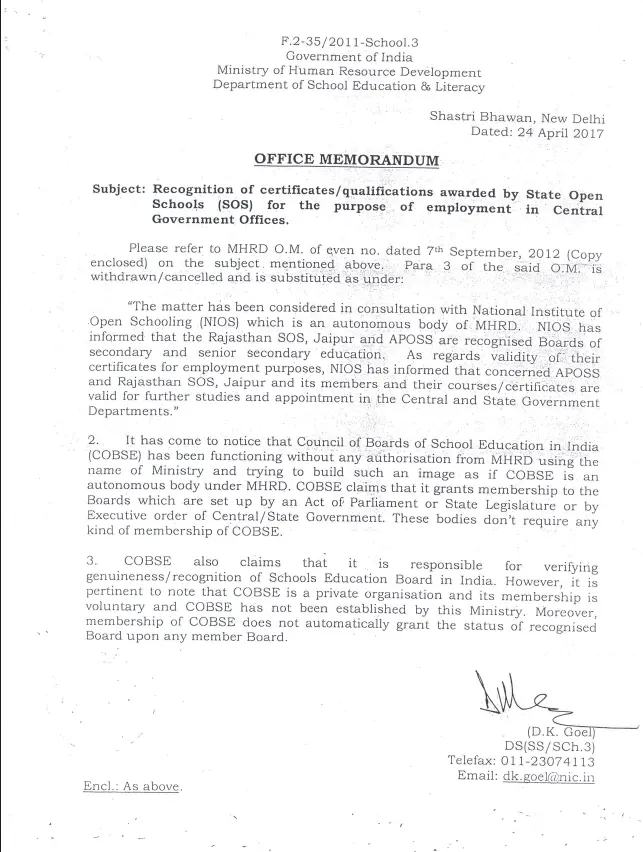
Q5. What did the Government of India clarify about COBSE in 2017?
The Ministry of Education officially clarified in 2017 that COBSE is a private voluntary society registered under the 1860 Act, with zero regulatory authority to grant, recognize, or de-recognize any education board in India.
8. Conclusion & Constitutional Summary
The imposition of mandatory COBSE membership is an illegal, unconstitutional, and administratively void practice. Educational governance in India is anchored in constitutional statutes, legislative acts, and official government gazettes—not in the membership rosters of private voluntary societies. Government authorities, educational administrators, and courts must uphold constitutional supremacy, protect institutional autonomy, and eradicate unlawful private society gatekeeping from India's education ecosystem.